


How Does Your Quality Control Work for Hunting Backpacks?
Short answer: Quality control runs through the whole order, not just the end of it. Every unit passes a documented six-step flow — fabric inspection, cutting, inspection after cutting, sewing, production inspection, packing — backed by incoming material traceability and dedicated QA/QC inspectors. Final inspection happens before shipment, and we welcome inspection by your own team or a nominated third-party agency.
The six inspection points
| Step | Stage | What is checked |
|---|---|---|
| 1 | Fabric inspection | Shade, coating and flaw check on incoming rolls |
| 2 | Cutting | Lay and cut accuracy against the approved pattern |
| 3 | Inspection after cutting | Panel dimensions and symmetry, before any sewing starts |
| 4 | Sewing | In-line check of stitch density, seam alignment and zipper run |
| 5 | Production inspection | Full-unit check: hardware function, closures, strap and buckle load points |
| 6 | Packing | Count, packing method, carton and label verification |
What is controlled and recorded
- Material traceability. Incoming fabrics and hardware are identified and recorded against the order, so a query can be traced back to a specific roll or component batch.
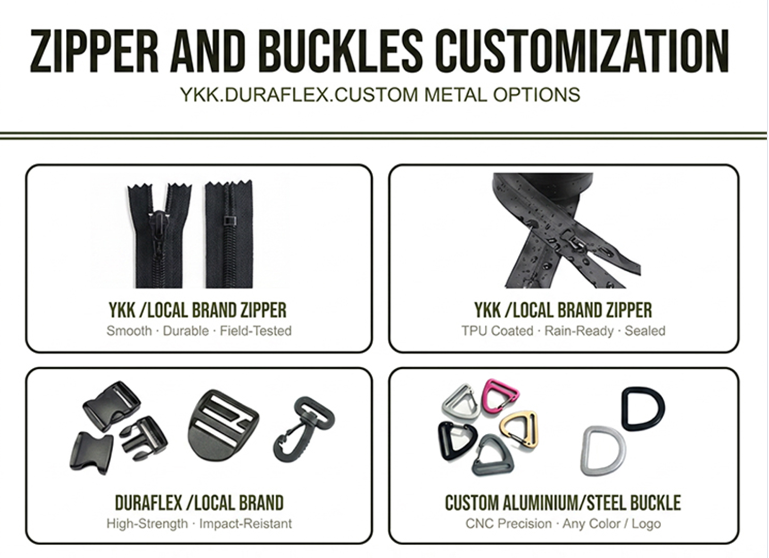
- Supplier assessment. Zippers, buckles, webbing and fabrics come from assessed suppliers, including YKK and Duraflex.
- In-line, not end-of-line only. Catching a stitch or zipper fault mid-run costs a rework. Catching the same fault after packing costs a shipment.
- Pre-shipment inspection. Final inspection against the approved sample and the agreed AQL standard, before the cartons are closed and loaded.
- Third-party option. Your inspector, your agency, your checklist — scheduled at a time you agree.
When a fault is found
Nothing is shipped on a promise that nothing went wrong. If inspection turns up a fault, the process is corrected rather than just the sample: affected units are pulled, the cause is identified at the step that produced it — cut, seam, hardware or packing — and the correction is applied to the run before final inspection is repeated.
The records matter here. Because incoming fabric and hardware are traced back to the order, a fault can be traced to a roll or a component batch instead of being argued about. That is how a complaint gets closed with evidence rather than an apology.
Warranty and after-sales
Every order carries a 12-month warranty on stitching and zippers, with replacement parts supplied free of charge. If a fault ever reaches your customer, we want the technical evidence as much as you do, because that is what stops it reaching the next order.
In-house testing, not just visual inspection
Visual inspection only catches what an inspector can see. Our lab runs physical tests on materials and finished components — tensile strength on webbing and straps, seam and buckle pull tests, and hardware cycling — so a specification is verified rather than assumed before it enters a production run.
Why this matters to a brand
An inspection process you can audit is what makes the second order identical to the first. Consistency, not a single perfect sample, is the product a factory actually sells.

july