loading

Professional Hunting Gear Manufacturer & Tactical Gear Supplier Since 2013

What Materials Are Used in Your Hunting Backpacks (Fabric, Frame and Quiet Hardware)?

2026-10-05

Short answer: Our hunting backpacks use brushed tricot or 500D / 1000D nylon and 500D Cordura for the shell, carbon fibre or aluminium external frames for load carriage, and YKK zippers with Duraflex buckles for hardware. Brushed outer faces and low-silence zipper pulls keep the pack quiet in the field. Every material is chosen against three criteria: quietness, abrasion resistance and weight.

Fabric library

Fabric Where it is used Why it is specified
Brushed tricot Outer face of quiet packs and bino harnesses Absorbs surface rustle; the quietest option we offer
500D nylon Main body of most hunting packs Best balance of weight and abrasion resistance
500D nylon ripstop Lightweight panels and liners Stops a tear from spreading
500D Cordura Frame packs, gun cases, high-wear bodies Highest abrasion resistance in the range
1000D nylon Reinforced trim and heavy-duty panels Maximum durability where abrasion is worst
600D–900D oxford Gun cases and value models Cost-effective toughness
Nylon with TPU coating Waterproof bodies and dry bags Sealed, two-sided weather protection
210D polyester + DWR Linings Stops internal moisture from spreading
What Materials Are Used in Your Hunting Backpacks (Fabric, Frame and Quiet Hardware)? 1
GAF OUTDOOR fabric library — brushed tricot, 500D nylon and ripstop, Cordura, oxford and TPU-coated nylon, with the camo and colour library

Frames and load carriage

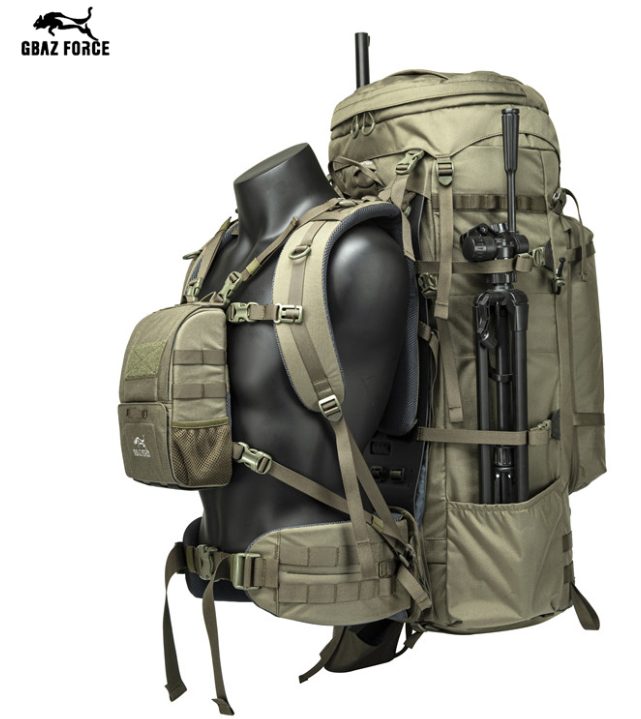
  • Carbon fibre frame — the lightest option, used on our high-end frame packs, and the one a hunter notices at hour eight.
  • Aluminium external frame — a higher strength-to-cost ratio, standard for value frame packs and heavy pack-outs.
  • Load shelf and meat bag — the interfaces that let a frame pack carry an animal quarter, rated to 150 lb / 68 kg on our lightweight aluminium model.

Quiet hardware

Noise is a material decision, not a sticker. A brushed face removes the rustle of a woven shell, and low-silence zipper pulls remove the second loudest sound a pack makes. Brushed-face builds measure roughly 30% quieter than an equivalent standard nylon build, with zipper operation below 40 dB. Buckles are Duraflex or assessed local equivalents, and the buckles plus roll-locks are the components that take the real load — which is why they are an inspection point in every order.

What Materials Are Used in Your Hunting Backpacks (Fabric, Frame and Quiet Hardware)? 2
GAF OUTDOOR zipper and buckle customisation — YKK and TPU-coated waterproof zippers, Duraflex buckles, CNC aluminium and steel hardware

Making the materials last

Two habits extend the life of a hunting pack more than any specification: keep the frame, buckles and zipper sliders clean of grit, and dry the pack open and unloaded rather than storing it compressed. Abrasion and UV exposure age every coating and fabric eventually, and checking the high-wear points — the base, the corners, the scabbard opening — once a season catches a repair before it becomes a replacement.

Where this gets written down for you

Every element above is a line item in your technical pack, so fabric, frame and hardware can be traded against cost, weight or quietness on a documented basis rather than a verbal one. That is what makes a specification repeatable from the first order to the fifth.

Next step: ask for the material specification for the model you are considering, or for the frame platform you want to build on.
prev
Can You OEM Hunting Backpacks With Our Own Design, Logo and Camo Pattern?
Related questions
1
Can You OEM Hunting Backpacks With Our Own Design, Logo and Camo Pattern?

Short answer: Yes. We build hunting backpacks to your design, your physical sample, or a design from our catalogue, with your logo, your colours and your camo. Custom OEM/ODM runs at 300 pieces per style; branding an existing design starts at 50 pieces. Camouflage fabric printed with your own pattern has a 1,000-yard fabric minimum, and we can help you apply for licensed patterns such as Realtree.

What you can specify

Element Options
Development route Your drawings, your physical sample, or a catalogue design to be modified
Structure Volume, pocket layout, frame type, load shelf, rifle scabbard, bow carrier, hydration sleeve
Fabric 500D / 1000D nylon, 500D Cordura, ripstop, brushed tricot, 600D–900D oxford, TPU-coated nylon
Camo Realtree, Next Camo, ABT Camo, Prym1, Mossy Oak, plus your own camo
Solid colour Pantone-matched dyed fabric
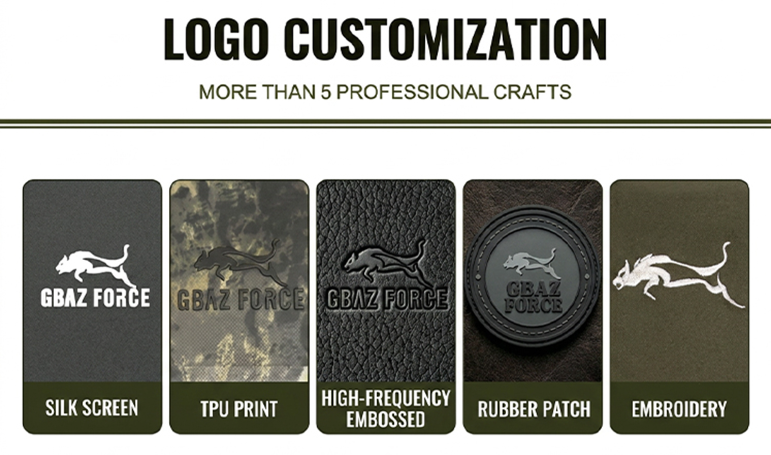
Logo craft Silk screen, TPU print, high-frequency embossed, rubber patch, embroidery
Hardware YKK zippers, TPU-coated waterproof zippers, Duraflex buckles, CNC aluminium or stainless buckles in any colour, logo-engraved
Packing Polybag, hangtag, retail carton, Amazon FBA-ready packing

GAF OUTDOOR logo customisation — five crafts: silk screen, TPU print, high-frequency embossed, rubber patch and embroidery

How the design stage works

Send a drawing, a sketch, a sample, or reference photography with the changes you want. Our design team returns a free pattern drawing and technical pack for your comment before sampling begins, so you approve the construction — not just a picture of it. Samples then follow in 7–15 days, and bulk production runs 45–65 days after approval.

A custom programme, stage by stage

Stage Time Your input Our output
Design 3–7 days Sketch, sample or reference Pattern drawing and technical pack
Sample 7–15 days Approval comments Physical sample with your camo and logo
Production 45–65 days Deposit and packing specification Finished order with inspection record
Shipping Per your terms Forwarder or DDP instruction FOB Shenzhen / Guangzhou or door delivery

Protecting your design

Exclusive styles stay exclusive. Your patterns and technical packs are not reused for other customers, and your camo or colour story is not offered to another brand on the same market. Confidentiality works in the other direction too: if a design of ours inspires yours, we will tell you which parts are free to use and which are licensed.

Why brands develop with us

We are a hunting backpack specialist, not a general bag factory with a hunting page. The whole range — frame packs, daily packs, bino harnesses, gun cases and slings, gaiters and vests — runs on one brand standard, one QC process and one shipping schedule, so a full season's launch stays on a single calendar. Our Guangzhou plant holds 20 production lines and 350+ staff across 3,300 ㎡, with an in-house design team that draws your pattern before the first sample is cut.

Next step: send your design or chosen model and we will return a technical pack and a sampling quote.

2
What Capacity Hunting Backpack Do I Need for Day Hunts vs Multi-Day Trips?

Short answer: For a single-day hunt, choose 20–35 L. For a long day, or a day that may end in a pack-out, choose 35–45 L. For two to four days out of a vehicle or a base camp, choose 65 L. For backpack hunts, fly-in trips and big-game pack-outs, choose 80 L or more. The deciding factor is not the number of days — it is whether you have to carry camp and an animal as well as your gear.

Capacity by trip type

Trip Volume Carries Model class
Tree stand / blind day hunt 13–25 L Layers, calls, food, water, optics 905-023 13L, 905-024 25L, 905-029 20L
Full day on foot 30–36 L Adds rain shell, first aid, extra water 901-08 30L, 905-047 36L
Long day with pack-out risk 35–45 L Adds a load shelf or meat bag 905-052 35L, 905-061 45L
2–4 days from camp 50–65 L Sleeping bag, stove, spare clothing 901-09 50L, 1932 65L, 905-030 65L
Backpack hunt / fly-in 80–85 L+ Camp plus an animal quarter 1931 80L, 905-031 85L

The four rules that matter more than the number

  • Meat changes everything. A single elk quarter weighs roughly 25–35 kg. Only a frame pack with a rigid frame, a load shelf and a real hip belt is designed to carry that out over broken ground.
  • Volume is not weight. A 45 L pack loaded to 20 kg is harder work than an 80 L pack at 15 kg. Match the pack to the load, not to the length of the trip.
  • Winter layers occupy volume fast. A load that fits comfortably in 35 L in October can need 50 L in January. Down and thick wool fill a bag quickly.
  • Smaller is quieter and handier. In timber and heavy brush, a 30 L pack clears branches and rides closer to the back, which is exactly where you want it in poor light.

Size your load before you size the pack

Write the list down and weigh it. For a general day hunt on foot, the kit usually lands between 5 and 9 kg including water; a pack-out day adds an animal quarter at 25–35 kg. A 35 L pack handles the first comfortably. The second is a frame-and-hip-belt question, not a volume question — which is why hunters who regularly pack out step straight to a 65 L or 80 L frame platform even for single-day trips.


GAF OUTDOOR 1931 80L carbon-fibre frame pack with side rifle scabbard and modular bino pouch — built for multi-day hunts and pack-outs

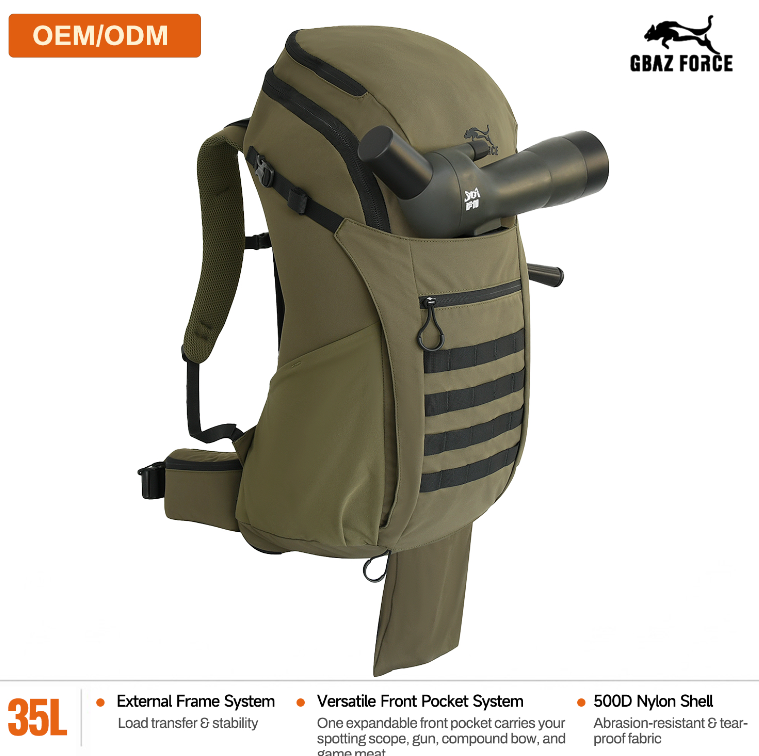
GAF OUTDOOR 905-052 35L external-frame hunting pack — front pocket sized for a spotting scope, MOLLE panel and 500D nylon shell

How we cover the whole capacity ladder

The frame platform behind our 20 / 45 / 65 / 85 L models is shared, so a brand can build a complete size family on one set of approvals instead of five separate developments. Carbon frames where weight matters most, aluminium external frames where value matters more, and 500D Cordura or 500D nylon shells across the range.

Next step: tell us the species, the terrain and whether you pack out and we will size the pack to the job.

3
What Is the Difference Between a Hunting Backpack and a Tactical Backpack?

Short answer: A hunting backpack is built to be quiet, camouflaged and load-bearing over distance, usually on an external frame that can also carry an animal out. A tactical backpack is built to be modular, abrasion-resistant and armour-compatible, usually in solid colours or military patterns, with MOLLE webbing and hydration or plate-carrier integration. The differences show up in four places: noise, colour, the frame, and the mounting system.

Side by side

Hunting backpack Tactical backpack
Primary job Carry gear and meat through rough terrain, unseen Carry equipment, plates or comms, modularly
Outer fabric Brushed tricot, 500D nylon, 500D Cordura, camo print 1000D nylon, ripstop, laser-cut laminate
Noise Brushed face and low-silence zips; operation under 40 dB Louder face, ripstop crackle, hook-and-loop tear
Colour Realtree, Next Camo, ABT, Prym1, own camo, Pantone solids Solid black, tan, ranger green, military patterns
Load carriage External carbon or aluminium frame, load shelf, meat bag Internal or none, often plate-carrier compatible
Modularity Silence-first: bino pouch, rifle scabbard, bow carrier MOLLE / PALS throughout: pouches, magazines, radios
Typical volume 20–45 L day, 65–85 L multi-day 12–35 L, plus assault packs
Best for Bow, rifle, elk, deer, turkey, waterfowl, driven hunts Range, training, law enforcement, security, field comms

Where the two designs trade off

Noise. A 1000D nylon face and a ripstop grid make a distinct rustle at exactly the moment a deer is inside 40 metres. A brushed tricot face on a hunting pack absorbs that surface noise, and low-silence zipper pulls remove the second loudest sound a pack makes.

Load. Tactical packs are generally sized to sit high and tight against armour. A hunting frame pack is sized to carry weight — including a quartered animal — with a load shelf, a rigid frame and a hip belt that transfers load to the hips.

Modularity. MOLLE is excellent for rigid, deliberate configurations. Hunting packs use it selectively and add purpose-built interfaces instead: a rifle scabbard, a bow carrier, a bino pouch, a game-call pocket.

What that means when you buy a hunting pack

Four specifications do the work, and they are the four to check on any pack you are considering:

  • A brushed outer face, not a ripstop grid — it is the single biggest noise difference you can buy.
  • Low-silence zipper pulls and closures, so the opening does not announce you at 40 metres.
  • A rigid frame plus a real hip belt, so an animal quarter transfers to your hips instead of your shoulders.
  • Hunting-specific interfaces — rifle scabbard, bow carrier, bino pouch, game-call pocket — instead of a wall of generic webbing.

GAF OUTDOOR 901-08 30L and 901-09 50L hunting backpacks in camo — the 30L covers tree-stand and day hunts, the 50L extends to long days and overnight loads

How we build for hunters

Every pack we make is designed around hunting rather than around a tactical specification with a camo print applied afterwards. That means brushed outer faces rather than ripstop crackle, aluminium or carbon frames and hip belts sized for an animal quarter rather than a plate, and attachment points chosen for the kit a hunter actually carries on the mountain. The range runs from 13 L day packs to 85 L frame packs, on one QC process and one shipping schedule.

Next step: tell us the hunt — species, terrain and carry weight — and we will recommend frame, volume and fabric.

4
How Long Does Sampling and Bulk Production Take for a Custom Hunting Backpack?

Short answer: For a custom hunting backpack, sampling takes 7–15 days once the design and camo are confirmed, and bulk production takes 45–65 days after sample approval and deposit. A complete OEM programme from first inquiry to loading runs 10–14 weeks. Repeat orders on an existing pattern typically ship faster, because patterns, tooling and material approvals are already in place.

The full OEM/ODM timeline

Stage Time What happens
1. Inquiry and quotation Within 24 hours Spec review, MOQ, unit price
2. Camo / design 3–7 days Pattern drawing, free tech pack, camo or Pantone approval
3. Sampling 7–15 days Physical sample produced and shipped for approval
4. Production 45–65 days Fabric in, cutting, sewing, inspection, packing
5. Payment — T/T 30% deposit + 70% before shipment, or Trade Assurance
6. Shipping DDP / FOB worldwide Air, sea or express per your terms

What actually moves the date

  • Fabric and camo. Stock 500D nylon is fast. A custom-printed camo or a licensed pattern adds print runs and approval steps to the critical path.
  • Hardware. YKK zippers and CNC aluminium buckles are bought against component minimums; unusual finishes or exclusive colours lengthen the order lead time.
  • Sample revisions. Each full revision round costs roughly one sampling cycle. Detailed feedback at round one is the cheapest time you will ever save.
  • Season peaks. Factory capacity tightens in the months before the North American and European hunting seasons. Booking a production slot early matters more than any other variable.

Planning a launch date

Work backwards from the season, not forwards from the deposit. If you need packs landed for a September season and sea freight takes 30–40 days, the production slot has to be booked by May. Approve the sample in the first half of that window and you keep the whole season.

What you receive at each stage

  • At quotation: unit price, MOQ, the sample and production windows, and the payment terms — in writing.
  • At design: the pattern drawing and technical pack, free of charge, for your sign-off before anything is cut.
  • At sampling: a physical sample built with the agreed fabric, camo and hardware, shipped for approval.
  • At production: the confirmed schedule, plus the inspection record and packing list when the order is completed.

That paper trail is what lets a purchase team defend a launch date internally, and what stops a timeline from being quietly renegotiated halfway through an order.


GAF OUTDOOR OEM/ODM order process and six-step production process — fabric inspection, cutting, inspection after cutting, sewing, production inspection, packing

Why our timeline holds

Sample and production schedules are quoted together, in writing, at the quotation stage — the 7–15 day sample window and the 45–65 day bulk window are commitments rather than estimates. A 24-hour reply guarantee means design questions do not sit unanswered while your production slot moves closer.

Capacity is what backs the date. Our Guangzhou plant runs 20 production lines with 350+ staff in a 3,300 ㎡ facility, cutting and sewing 30,000–50,000 backpacks a month — which is why a 300-piece order is a scheduled block rather than a gap-filler, and why orders placed before the pre-season rush keep their original window.


GAF OUTDOOR sewing floor in Guangzhou — bulk runs are cut and sewn on dedicated lines with in-line inspection at each station

Next step: tell us your target landing date and we will build the schedule backwards from it.

5
What Is the MOQ for Custom Hunting Backpacks?

Short answer: Custom OEM/ODM hunting backpacks start at 300 pieces per style (a small number of models are quoted at 500). If you want your brand on a design we already make, the branded stock programme opens at 50 pieces, and designs held in ready stock can ship from as few as 5–8 pieces. Camouflage fabric printed with your own pattern carries a separate fabric minimum of 1,000 yards.

MOQ by order type

Order type Minimum What you get Best for
In-stock design 5–8 pcs Existing pack, our branding removed, labels as agreed Testing a new market or channel
Branded stock programme 50 pcs Your logo, labels and hangtags on an existing design Distributors and online retailers
Custom OEM/ODM 300 pcs per style Your design, patterns, colours and hardware Brands building an exclusive line
Your own camo print 1,000 yds of fabric Custom-printed camouflage on your chosen base cloth Brands with a signature pattern
Sample 1 pc Physical reference sample before commitment Every project

Why the 300-piece threshold exists

Three real production limits set it: fabric dye-lot minimums (a mill will not run a custom colour for a handful of packs), camo print runs, and cutting efficiency — layering and cutting 300 units of one style costs roughly the same machine time as 30. Hardware follows the same logic, because YKK zippers and Duraflex buckles are ordered by component minimum, not by finished bag.

Three ways to lower your opening order

  • Start on a stock design at 5–8 pieces per colour, then move to a custom run once the market answers.
  • Order fewer colours, more depth. 300 pieces in two colourways costs far less per unit than 150 in four.
  • Order a size family on one body. Our frame packs share a common platform across 20 / 45 / 65 / 85 L, so volumes can be pooled across sizes instead of split between them.

GAF OUTDOOR custom and OEM panel — logo, colour, size and structure available, MOQ 300 pcs

How MOQ interacts with your unit price

Volume is not the only lever. Per-unit cost falls when the specification is stable across the run — one fabric, one colourway, one hardware set — because tooling, cutting and inspection time are shared. Adding a second camo mid-order costs more than adding it at the design stage, which is why the specification is fixed before sampling rather than during production. Volume discounts are quoted per order, not held back for a later negotiation.

Why our MOQ is workable for smaller brands

We quote the number you will actually be asked to place — no inflated minimum that quietly becomes 1,000 at the deposit stage. Design work, including pattern drawing and a free technical pack, happens before you commit to the 300, so the project is fully costed by the time you see a sample. Inquiry replies come within 24 hours and samples are produced in 7–15 days.

Our plant in Guangzhou covers 3,300 ㎡ with 20 production lines and 350+ staff, so a 300-piece run is a normal production block rather than a special favour — and a 50-piece branding order does not have to wait for a larger customer to fill a line.

Next step: send your design, reference sample or chosen model and we will return MOQ, unit price and lead time against your target.

What Is the MOQ for Custom Hunting Backpacks?

GAF OUTDOOR · hunting backpack manufacturer in Guangzhou, China · contact us 

GET IN TOUCH WITH Us
Add:
1# Shangjie Hehe Road Hecheng Shiling Town Huadu District Guangzhou City 510850 China
Contact person

july

Have any questions?
july-bags@foxmail.com
Call us
+86 13922517997
Follow us
Copyright © 2026 GAF | Sitemap
Customer service
detect