



Short answer: Binoculars go in a chest harness, the rangefinder goes in its own pouch on the harness wing or on your belt — not in the same pocket, and not on a neck strap. A chest rig holds the binoculars flat against your chest for one-handed glassing, and a 6 in rangefinder pouch with a magnetic closure lets you range a target and stow it without looking down. Add a 6.7 in bear spray pouch on the opposite hip and the kit rides without a strap around your neck.
Where each item should ride
| Item | Best position | Why |
|---|---|---|
| Binoculars | chest harness main pouch | one-hand access while glassing |
| Rangefinder | harness wing or belt | range without moving the binoculars |
| Bear spray | opposite hip, cross-draw | reachable with either hand |
| Calls, licence, gloves | pouch under the bino pack | keeps bulk off the harness |
What to look for in the pouches
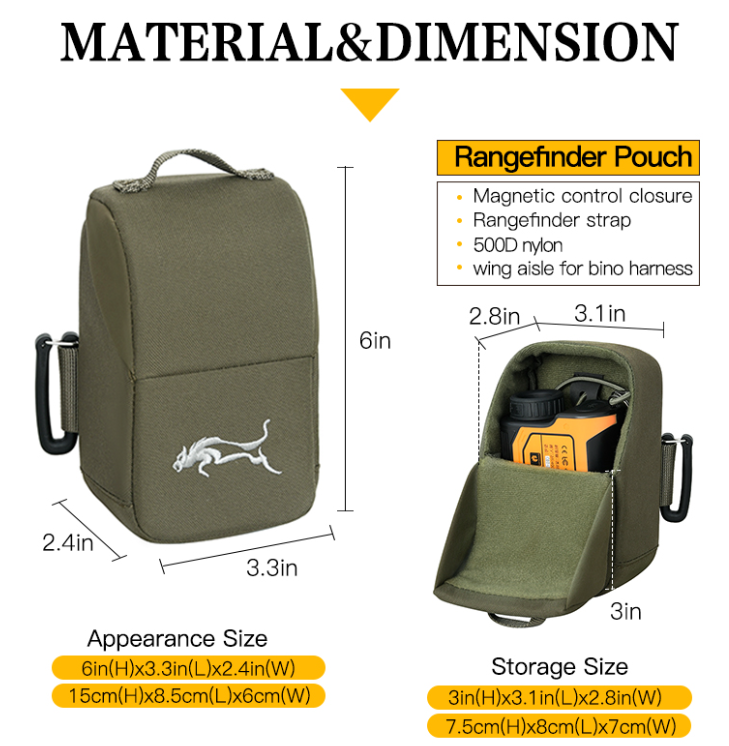
- Magnetic closure. Quiet, one-handed, and no zip to fumble when a bull steps out — the 905-016 uses a magnetic control closure.
- A tether. A rangefinder dropped from a treestand is a rangefinder lost; specify a strap inside the pouch.
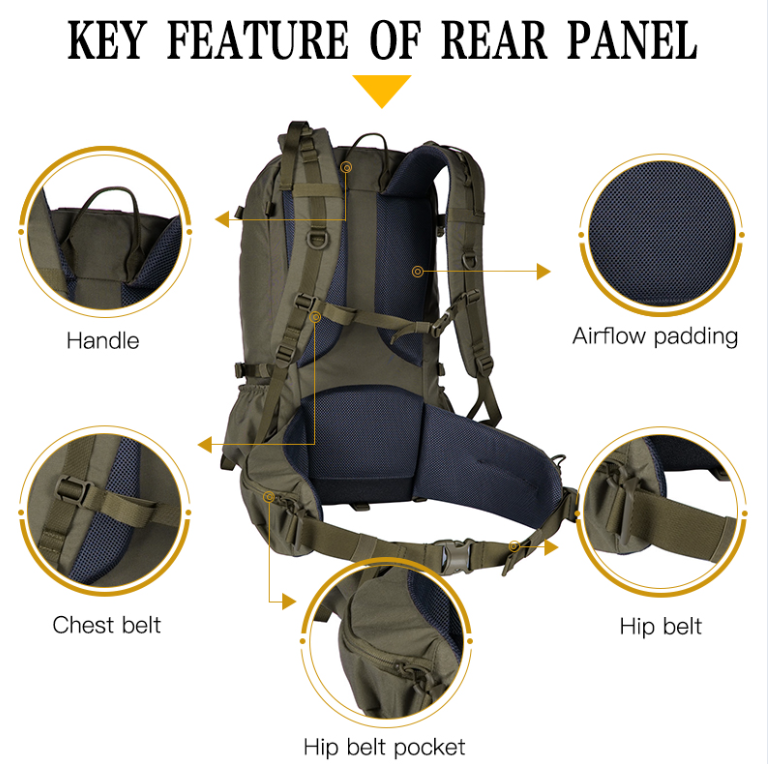
- Harness compatibility. A wing aisle threads the pouch onto the bino harness so it sits beside the binoculars instead of swinging from the belt.
- MOLLE and belt loops. For hunters running a waist pack, the same pouch should mount on webbing — the 905-021 bear spray pouch takes MOLLE as well as a loop and buckle.
- Shell fabric. 500D nylon holds its shape, resists burrs and stays quiet enough for close cover.
- Size to the device. The 905-016 takes a rangefinder up to 3 × 3.1 × 2.8 in internally; check your model before ordering.
Building the kit as one system
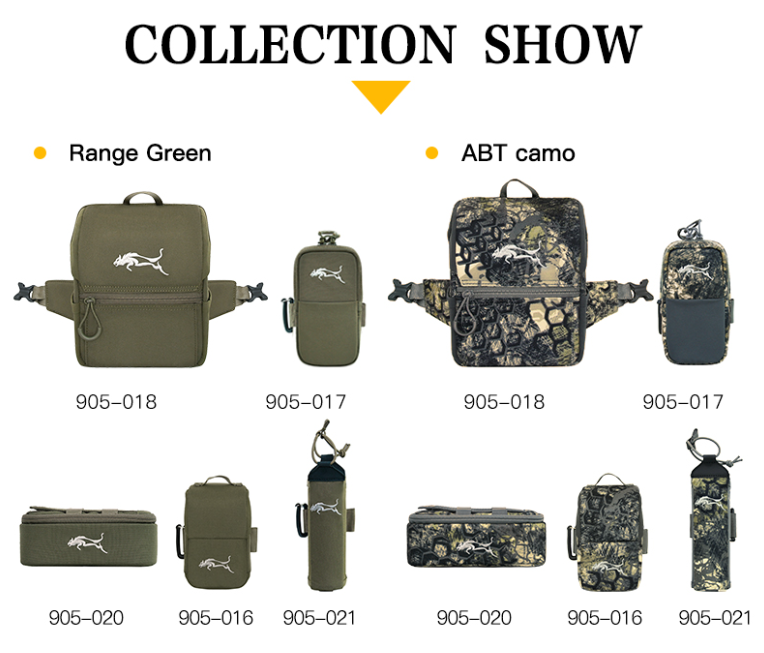
A harness, rangefinder pouch, utility pouch and spray pouch that share the same webbing keep the load symmetrical and stop anything dangling. Keep the heavy item — the binoculars — centred on your chest, put the rangefinder on your bow-hand side if you range before you draw, and carry the spray on the opposite hip so a draw never crosses your body.
Why brands source optics pouches from GAF OUTDOOR
One factory builds the harness and every pouch that clips to it: 10+ years of OEM/ODM, 20+ designers, 20 production lines and an in-house test lab, so webbing alignment, magnet strength and stitching are checked as a set. Custom runs from 300 pcs per colour, private label from 50 pcs, stock from 5–8 pcs, with 7–15 day samples, 45–65 day bulk and Range Green or ABT camo stock colourways.
Next step: see the binocular harness range or send us your device dimensions.
Short answer: Both, for different hunts. A waist pack of 2–6.5L keeps the essentials — calls, rangefinder, shells, phone, a bottle — on your hips with nothing on your back. A day pack carries clothing, food, hydration and a harvest. On short sits, driven hunts and turkey mornings the waist pack alone is enough; when you also carry a bow or a decoy, run the waist pack on the pack's belt. Custom waist packs start at MOQ 300 pcs.
Waist pack vs day pack vs frame pack
| Waist pack | Day pack | Frame pack | |
|---|---|---|---|
| Typical capacity | 2–6.5L | 18–40L | 40–120L |
| Weight sits | on the hips | shoulders and hips | hips, on a frame |
| Access while seated | yes | no | no |
| Sweaty back | none | yes | yes |
| Carries a harvest | no | limited | yes, with a load shelf |
| Best for | driven hunts, turkey, treestands | one-day hunts | multi-day and pack-out |
Why hunters carry a waist pack
- Silence first. A brushed tricot shell is the quietest face fabric we stock — no rustle when you turn to call or reach for a rangefinder.
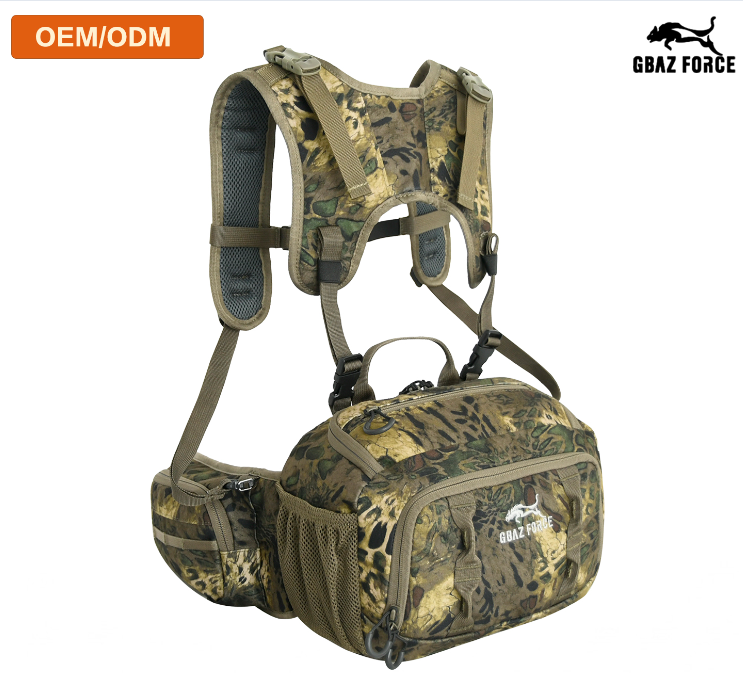
- A detachable harness. The shoulder harness spreads the load on long walks and removes in seconds when you want a plain fanny pack.
- Access when sitting. Everything sits in front of you, which matters in a treestand or a blind.
- No sweaty back. Nothing presses against your spine on a warm stalk.
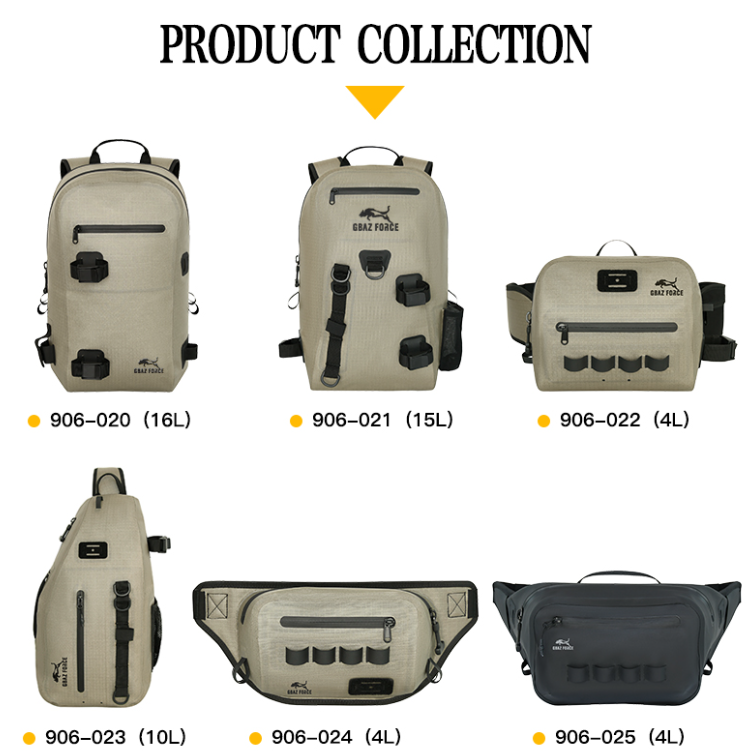
- Waterproof options. Our 906 range includes 4L waterproof waist packs (906-022, 906-024, 906-025) plus 10L, 15L and 16L bags in the same series for wet hunts and wading.
What to specify on an OEM waist pack order
- Capacity tiers. 4L covers calls, a phone and a bottle; 6.5L adds a rangefinder, gloves and a snack.
- Harness type. Belt only, or belt plus a detachable shoulder harness — say which on the tech pack.
- Pocket layout. Purpose-built pockets for Western big game differ from upland bird or turkey layouts.
- Fabric and hardware. Brushed tricot, 500D nylon or TPU-faced shells, with YKK zippers and Duraflex buckles.
- Waterproofing claims. On a sealed waterproof waist pack the airtight zipper is the rated component — that is not the same as a rating for the whole bag.
- Order terms. Custom from 300 pcs per colour, private label from 50 pcs, stock from 5–8 pcs, with 7–15 day samples and 45–65 day bulk production.
Why brands source waist packs from GAF OUTDOOR
Waist packs, day packs and frame packs are built on one platform: 10+ years of OEM/ODM, 20+ designers, 20 production lines and an in-house test lab, backed by a 12-month warranty and FOB or DDP terms.
Next step: see the waterproof waist pack or send us your capacity and pocket list.
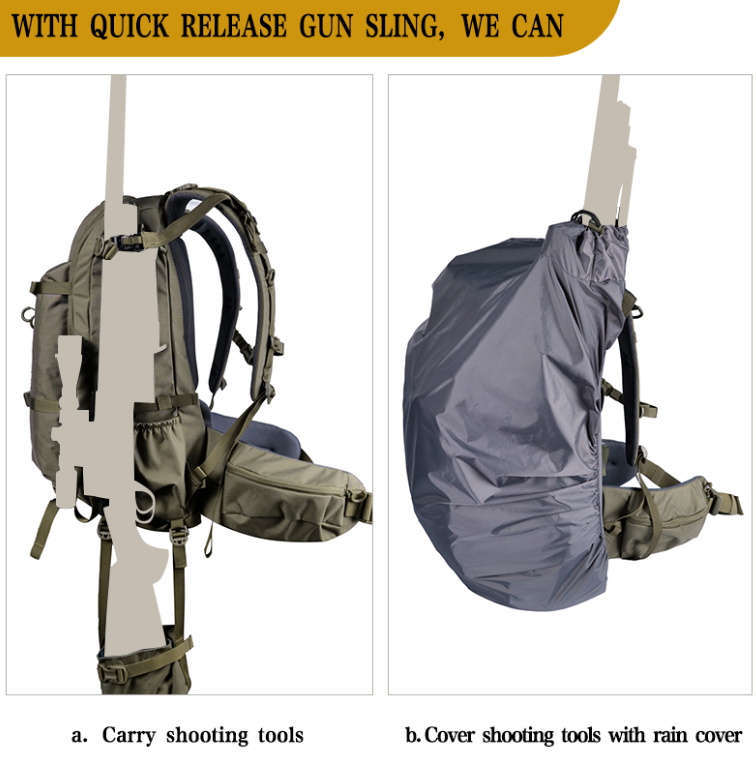
Short answer: Not always. Some hunting packs ship with a cover stowed in a pocket or under the lid, some rely on a DWR water-repellent finish alone, and a few are welded waterproof bags that need no cover at all. In our range, the 40L 500D Cordura bow day pack and the 85L carbon-frame pack both ship with a cover, and the 905-018 bino harness pack is supplied with one. Custom runs start at MOQ 300 pcs.
The three levels of wet-weather protection
| DWR finish | Rain cover | Welded waterproof bag | |
|---|---|---|---|
| What it handles | light rain, snow, splash | steady, all-day rain | submersion, river crossings |
| Where it lives | on the fabric itself | in a pocket or under the lid | the bag construction |
| Weak points | wets out over long exposure | wind, and it must fit the load | heavier, less internal organisation |
| Typical use | most hunting days | waterfowl, float trips, long sits | boat, canoe, wading |
What a rain cover has to cover
- The load, not just the pack. A cover cut for an empty 40L pack will not stretch over a bow carrier, a rifle sling or a loaded meat shelf — specify it against the pack's maximum dressed size.
- Where it lives. A cover sewn into the base or lid gets used; a loose cover left at home does not.
- The zips and the lid. Water runs down the top first, so ask whether the seams are taped or sealed.
- Attachment. An elastic hem plus a clip keeps the cover on in wind.
- Visibility. A high-visibility cover is safer in low light; camo suits open-country hunting.
What to specify on an OEM rain cover order
- Shell fabric. 500D Cordura nylon with a DWR face, or a nylon body with a DWR + PU coating; brushed tricot shells take a DWR + TPU bond.
- Be precise about waterproofing. A DWR finish repels rain but is not a waterproof construction, and even an IPX7 airtight zipper is rated as a component, not as a rating for the whole pack.
- Fit and packing. State the pack's loaded volume, whether the cover must clear a bow or rifle carrier, and whether it packs into its own pocket.
- Order terms. Custom covers from 300 pcs per colour, 50 pcs for private label on an existing design, 7–15 day samples and 45–65 day bulk production, FOB or DDP.
Why brands buy wet-weather gear from GAF OUTDOOR
Pack and cover are built on the same line: 10+ years of OEM/ODM, 20+ designers, 20 production lines and an in-house test lab, so cover fit, seam sealing and zipper performance are checked before shipping — backed by a 12-month warranty.
Next step: tell us your pack volume and how you hunt and we will specify the cover to match, or see the waterproof dry bag range.
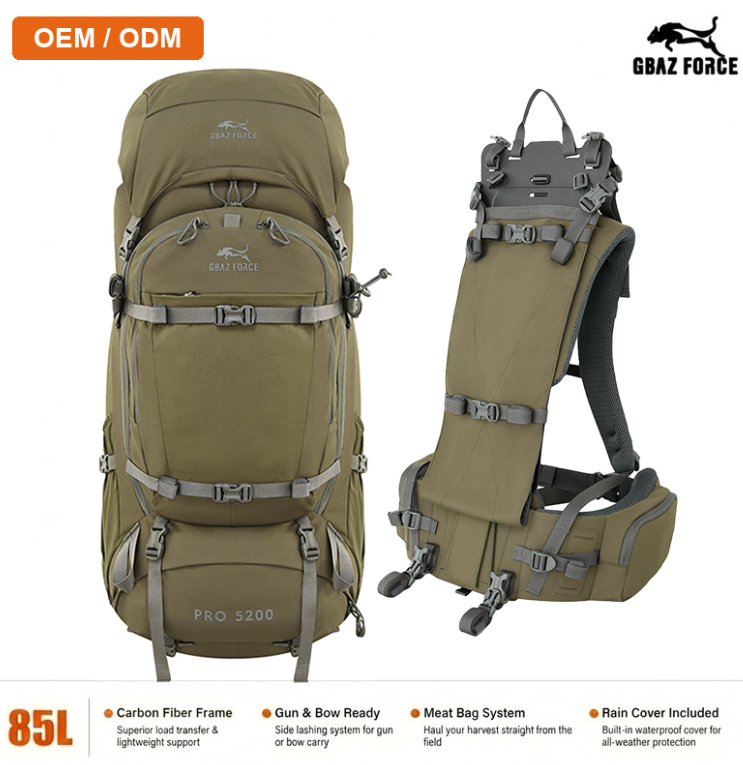
Short answer: There is no single number, because the limit is set by the frame and the suspension, not by the fabric. As a working rule, a frameless day pack is fine for a light day load, while a framed pack with a proper hip belt carries a multi-day load plus a deboned harvest. Our carbon-fibre frame platform spans 30L to 120L, and the lightweight aluminium-frame pack ships with a 150 lbs (68 kg) meat bag.
What actually sets the limit
| Part | Why it decides the load |
|---|---|
| Frame | The spine of the pack. Carbon fibre stays light; aluminium takes repeated meat hauling at lower cost. |
| Hip belt | Transfers most of the weight to the pelvis, so the shoulders carry only a fraction. |
| Load lifters and shoulder straps | Fine-tune how close the load sits to your spine. |
| Fabric | 500D Cordura nylon and 500D/1000D nylon resist abrasion — but denier alone does not create capacity. |
| Hardware and stitching | YKK zippers, Duraflex buckles and bar-tacked seams are what fail first when a pack is overloaded. |
Our frame platforms at a glance
| Platform | Frame | Sizes | Suited to |
|---|---|---|---|
| Frameless day pack | none | 18L–35L | fast day hunts, light gear |
| Carbon-fibre frame pack | carbon fibre | 30L–120L | long approaches, multi-day big game |
| Aluminium frame pack | aluminium | 65L–85L | heavy, repeated meat hauling |
A load figure only means what it was tested for. The 120 kg rating on our 30L stool pack, for example, applies to the metal seat frame, not to the pack body. Ask what a number refers to before you pass it on to your own customers.
Four rules for carrying a heavy load
- Keep dense items high and close to the spine, between the shoulder blades, not at the bottom of the bag.
- Tighten in order: hip belt first, then shoulder straps, then load lifters. If the pack sags, the frame is not sitting on your hips.
- Use the load shelf. Strapping a deboned harvest between the bag and the frame lowers the centre of gravity and stops it swinging.
- Plan for two trips. A 150 lbs meat bag describes the bag's capacity; walking out with that much in one go is the hunter's decision, not the spec sheet.
Why brands source load-bearing packs from us
We build the frame, the bag and the carry system under one roof: 10+ years of OEM/ODM, 20+ designers, 20 production lines and an in-house tensile-test lab, so load-bearing seams, webbing and buckles are checked before shipping. Custom OEM runs from 300 pcs per style, private label from 50 pcs, stock from 5–8 pcs, with 7–15 day samples, 45–65 day bulk production, FOB or DDP, and a 12-month warranty.
Next step: send us your target capacity and load and we will recommend the frame and suspension to match, or see the hunting backpack range.
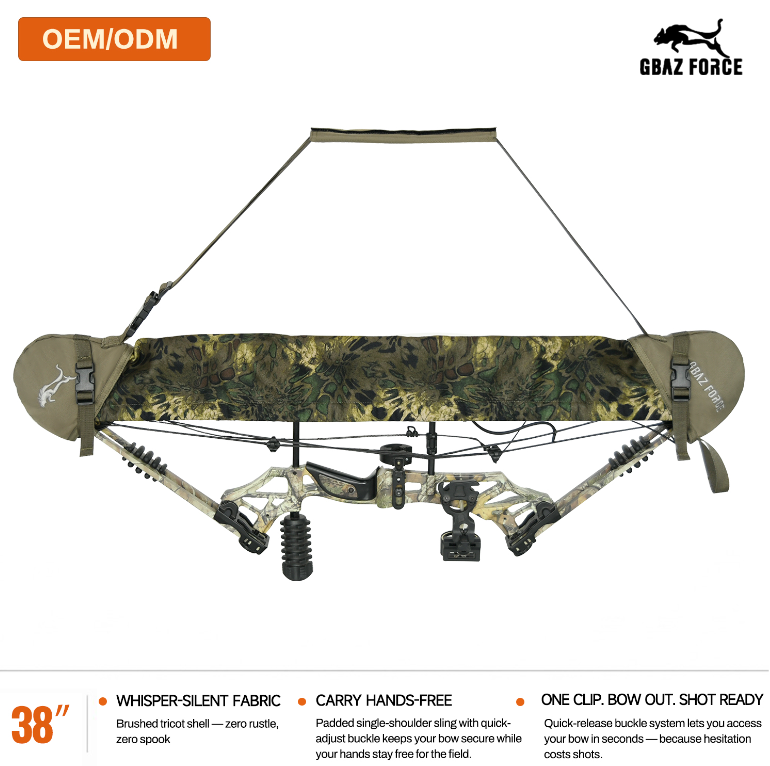
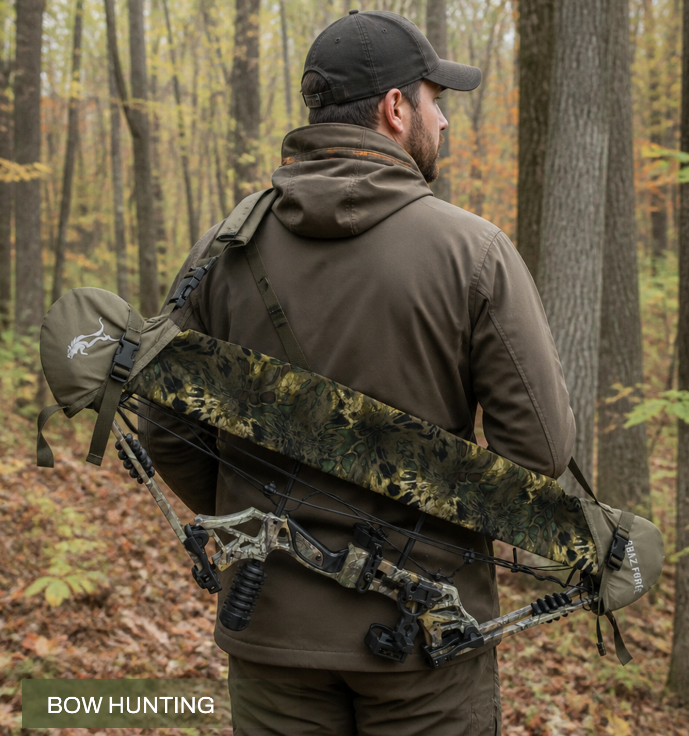
Short answer: A bow case carries the bow and nothing else. Its job is to protect the cams and string from knocks, and get the bow onto your back so your hands stay free. Two families cover it: a padded soft sleeve with a sling, which is what you carry in the field, and a hard travel case, which is what you fly with. Our 1944 is the soft kind — 38 in, brushed tricot shell, padded single-shoulder sling and a quick-release buckle.
The three ways to carry a bow
| Soft bow sleeve + sling | Hard travel case | Bow pocket on a hunting pack | |
|---|---|---|---|
| Carries | Bow only | Bow plus accessories | Bow inside the pack |
| Protection | Padding against knocks | Rigid shell against impact | Padding, plus the pack around it |
| Hands | Free, sling on shoulder | Free, fixed handles | Free |
| Access | One clip | Latches | Open the pack |
| Airline travel | Not designed for it | The right choice | No |
| Best for | Walk-in, tree stand, stalking | Flying, off-season storage | Spot and stalk, one-load carry |
What to check before you buy or specify
- Length against your bow. Measure axle-to-axle and overall length, then compare with the case size rather than the bow's advertised class.
- Padding at the cams. The cams and the string are the parts you cannot repair in the field; ask where the padding is thickest.
- A quiet shell. Brushed tricot runs silent against brush and clothing, which matters more on a bow case than on any other bag.
- The sling. A padded, quick-adjust sling is what makes the case wearable for a mile, not a hundred metres.
- Closure and access. A single quick-release buckle gets the bow out in seconds; zip closures are slower but hold the bow more securely.
- Weather. A water-repellent face is enough for most days; ask for a coated shell if you hunt in sustained rain.
Case or pack — which comes first
If you already carry a bow hunting backpack with a bow pocket or side carrier, the case is for transport and the off-season, not the hunt. If you walk in with the bow on your shoulder and put a small day pack on your back, the sleeve is the item you actually need. Many bowhunters end up with both; the sleeve is the cheaper half.
Why brands source bow carry from us
GAF OUTDOOR has 10+ years of OEM/ODM experience and 50+ brand customers in the US, Europe and Australia, from a 3,300 ㎡ plant with 20 production lines and 350+ staff. Bow sleeves, bow packs and bow carriers are built on the same brushed-tricot, camo and hardware platform as our hunting packs — sample in 7–15 days, custom OEM from 300 pcs per style, branding an existing design from 50 pcs.
Next step: see the hunting accessories range, or send your bow's overall length and we will match the case size.
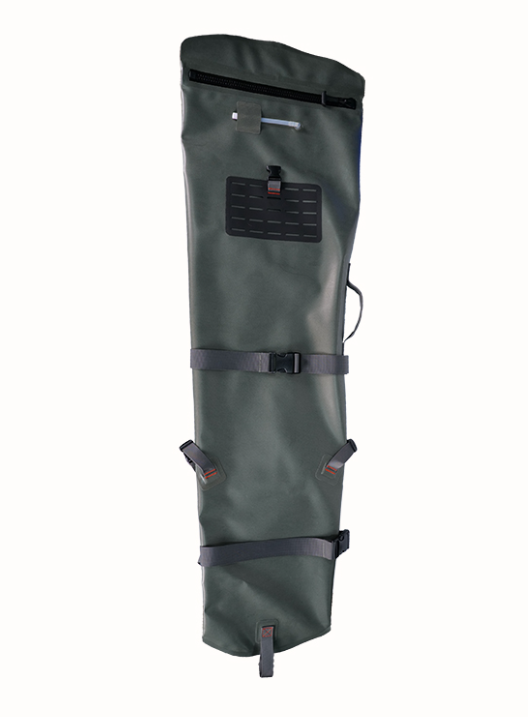
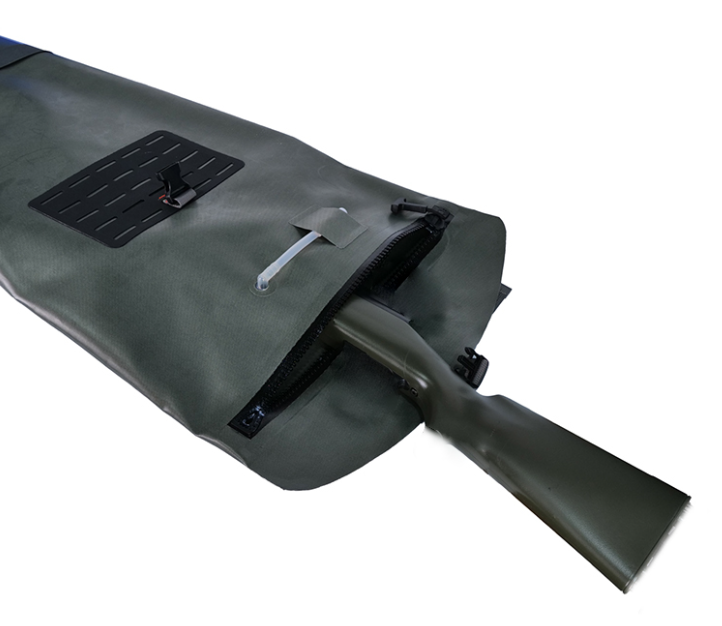
Short answer: A floating gun case is a welded, fully waterproof case — sealed seams, a waterproof closure and a body designed to stay on the surface if it goes over the side. It is right when you hunt from a boat, wade to a blind or cross water, and wrong when you fly with a rifle. Our 2015 model uses welded waterproof fabric with a full-length waterproof zipper, two cinch straps and a laser-cut MOLLE panel.
Floating case vs soft case vs hard case
| Floating welded case | Padded soft case | Hard case | |
|---|---|---|---|
| Water | Sealed body, floating design | Water-resistant fabric only | Weather-resistant, not sealed |
| Impact | Padding only | Padding | Rigid shell |
| Airline travel | Not designed for it | Not designed for it | The right choice |
| Attachment | MOLLE panel and cinch straps | Sling | Fixed handles |
| Best for | Boat, wade-in, flooded timber | Truck, blind, day hunts | Flying, long-haul |
What to check before you buy or specify
- Welded, not sewn. Ask whether the body is welded or stitched. A sewn and taped case is water-resistant; a welded case is the one that keeps water out.
- Closure type. A full-length waterproof zipper gives fast access; a roll-top gives a simpler seal but slower handling. Match it to how you use the case.
- Cinch straps. Two straps let you compress the case around the gun so it does not shift, and they double as lashing points on a boat.
- Buoyancy in writing. Ask the supplier for the buoyancy and sealing specification rather than trusting the word "floating" on a product title.
- Length and fit. A waterfowl case usually takes a longer, scoped gun — measure muzzle to buttstock with the choke tube fitted, and check the case against that number.
- Attachment. A MOLLE or laser-cut panel lets the case ride on a pack or a blind frame instead of in your hands.
It is not just the gun
On a waterfowl hunt the gun is one of several things that must stay dry. The same welded construction runs through our dry bags: a 37 L 840D nylon camo TPU dry backpack and a 50 L / 100 L floating waterproof duffel, both built with an IPX7 airtight zipper on a submersible body.
Why brands source waterfowl gear from us
GAF OUTDOOR has 10+ years of OEM/ODM experience and 50+ brand customers in the US, Europe and Australia, from a 3,300 ㎡ plant with 20 production lines and 350+ staff. Floating gun cases, dry bags and decoy bags come off the same welding and camo platform, so a waterfowl line can be sourced in one place — sample in 7–15 days, custom OEM from 300 pcs per style, branding an existing design from 50 pcs.
Next step: see the gun bag range, or send your barrel length and hunting conditions and we will match the case.
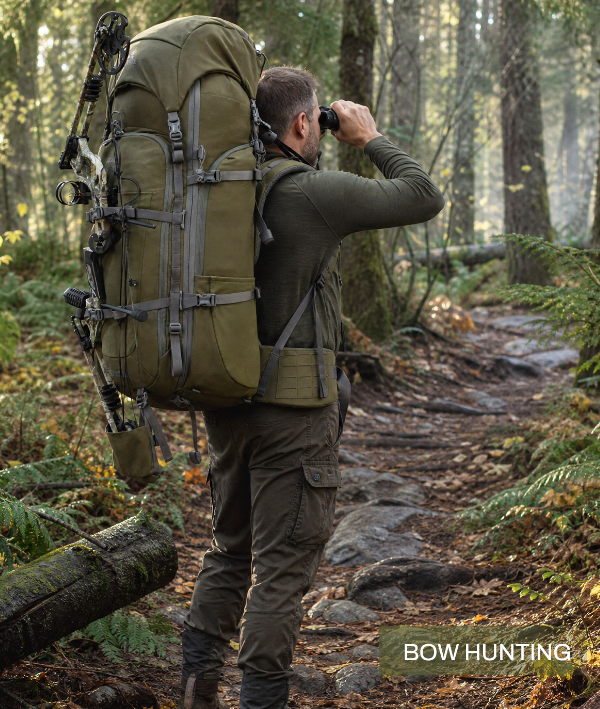
Short answer: A bow hunting backpack has to do one thing a rifle pack does not: carry a compound bow hands-free without the cams or string dragging through brush. Three decisions cover it — where the bow rides (inside the pack or on a side carrier), capacity (20–40 L covers spot and stalk and tree stands), and how quiet the shell is. Our bow packs run from a 20 L day pack to an 80 L carbon-frame model.
Where the bow goes
| Bow inside the pack | Bow on a side carrier | Separate bow case | |
|---|---|---|---|
| Hands free | Yes | Yes | No — carried separately |
| Access | Open the pack | Release the carrier straps | Immediate |
| Protection | Bow enclosed | Bow exposed | Highest |
| Best for | Walk-in, tree stands | Spot and stalk | Transport and travel |
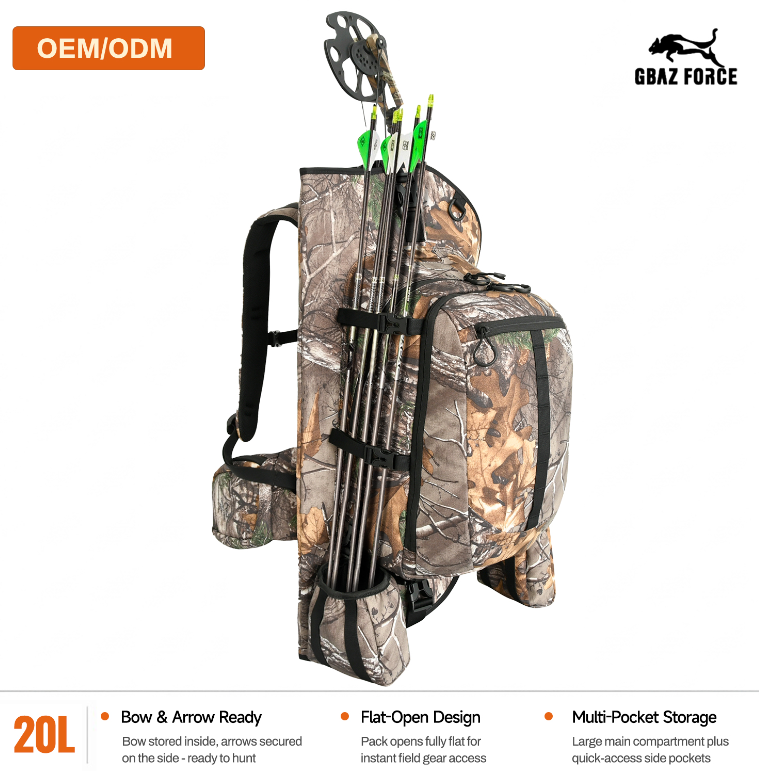
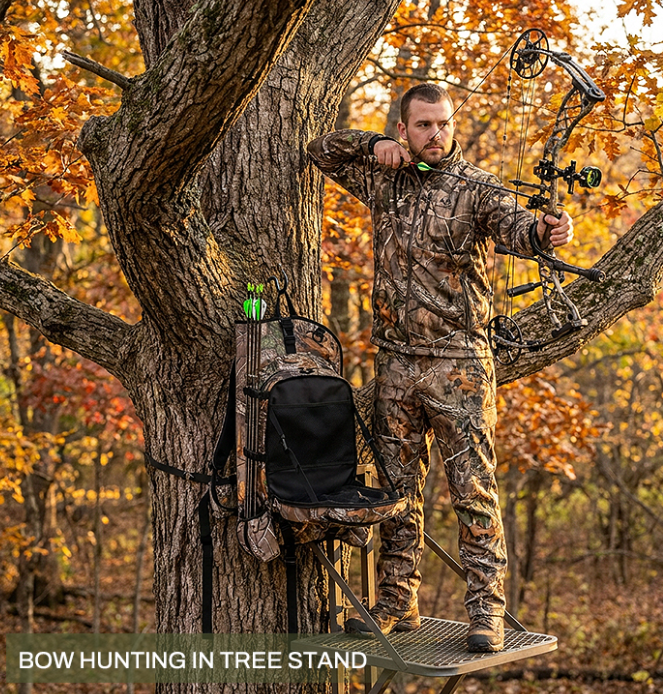
The 905-060 20 L does both: the bow stores inside the pack and the arrows are secured on the side, so the whole rig is ready when you reach the stand.
Capacity ladder
| Capacity | Model | Suits |
|---|---|---|
| 20 L | 905-060 | Spot and stalk, half-day hunts |
| 30 L | 30 L bow hunting pack with bow carrier | Full day, tree stand |
| 40 L | 1933 — 500D Cordura, aluminium frame, Bow & Rifle Carry System | Full day plus layers; bow or rifle |
| 65 L | Carbon external-frame pack with bow carrier | Multi-day hunts |
| 80 L | Carbon frame bow pack with bow carrier | Backpack bow hunts |
What to check before you buy or specify
- Bow carry position. Inside the pack protects the cams on a walk-in; a side carrier is faster to draw from in a spot-and-stalk setup. Decide from the hunt, not the catalogue.
- Retention points. Count the straps and cradle points. Two straps hold a bow; two straps plus a bottom cradle hold it securely.
- Cam and string clearance. The bow must sit so nothing presses on the cams or the string — a structural decision, fixed in the technical pack.
- Quiet shell. Bow hunting is a close-range game. Brushed faces are quieter than ripstop, and low-silence zippers remove the second loudest sound a pack makes.
- A tree-stand hook or lashing loop. On a stand the pack gets hung, not worn — our packs carry attachment loops for exactly that.
- Flat-open access. A pack that opens fully flat means you reach everything without unpacking it on a platform.
Why brands source bow packs from us
GAF OUTDOOR has 10+ years of OEM/ODM experience and 50+ brand customers in the US, Europe and Australia, from a 3,300 ㎡ plant with 20 production lines and 350+ staff. Bow carry systems, camo, hardware and quiet shells come off the same platform as our rifle packs — sample in 7–15 days, custom OEM from 300 pcs per style, branding an existing design from 50 pcs.
Next step: see the 20 L bow hunting backpack, or send your bow's overall length for a fit recommendation.
Short answer: Three things decide it: capacity (2 L for a day, 3 L for long days or hot weather), the liner build (EVA or TPU), and whether your pack actually has a bladder sleeve and a tube port. A bladder is only useful if the hose reaches your mouth without stopping to unshoulder — so check the tube length and the routing, not just the litres.
The decisions
| Decision | Options | Pick it when |
|---|---|---|
| Capacity | 2 L | Day hunts, cool weather |
| 3 L | Long days, heat, no refill points | |
| Liner build | XY01 (EVA) | Standard soft reservoir |
| XY02 (TPU) | The alternative build — we quote both | |
| Closure | Wide screw cap | Easier filling and drying |
| Tube end | Shut-off bite valve | You want no drips inside the pack |
| Pack fit | 2 L / 3 L sleeve plus a port | Almost always the deciding factor |
Bladder or bottle?
| Hydration bladder | Bottle in a pouch | |
|---|---|---|
| Hands | Free — you drink on the move | Stop and reach |
| Capacity | 2–3 L continuous | One bottle at a time |
| Pack fit | Needs a sleeve and a tube port | Needs a side pocket or pouch |
| Cleaning | More work; dry it fully | Simple |
| Best for | Long walks, stalking, still hunting | Short hunts, hot drinks, backup |
The numbers
| Item | Spec |
|---|---|
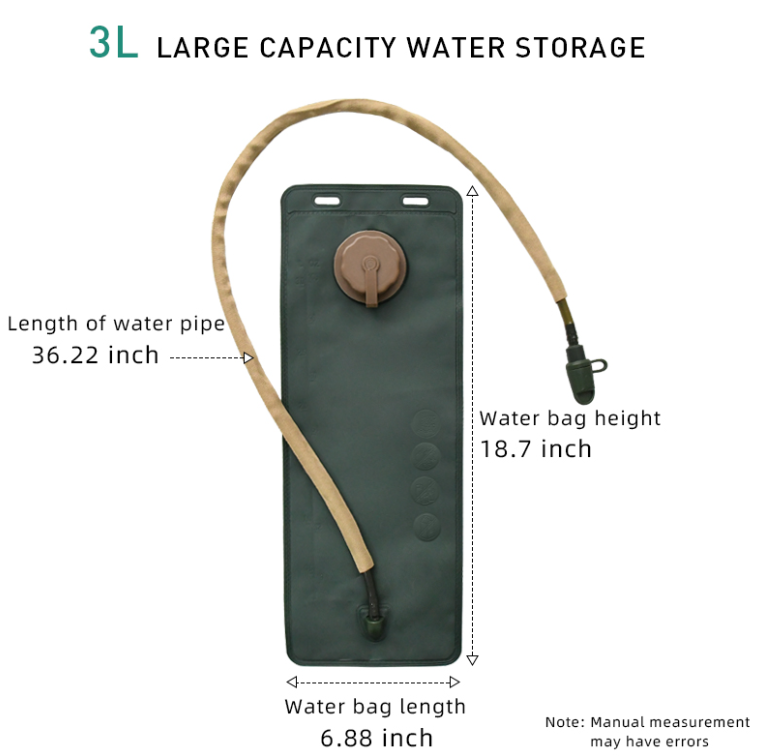
| 3 L bladder | 6.88 in long × 18.7 in high |
| Drinking tube | 36.22 in |
| Liner builds | XY01 (EVA) and XY02 (TPU) |
| Bottle pouch, 905-048 | 6.5 in high × 3.1 in wide, circumference 7.9–11.5 in |
| Pouch fabric and weight | 500D nylon, 0.03 kg |
What to check before you buy or specify
- Tube length. 36.22 in of tube is what lets the hose run from a sleeve, up over the shoulder and still reach the bite valve.
- The sleeve. Confirm the pack has a dedicated 2 L / 3 L sleeve and a port for the tube to exit; a hydration sleeve is a standard structural position on our packs.
- Closure size. A wide screw cap is far easier to fill from a stream and to dry out afterwards.
- A shut-off bite valve. It stops the line draining into your pack when the hose sits below the bladder.
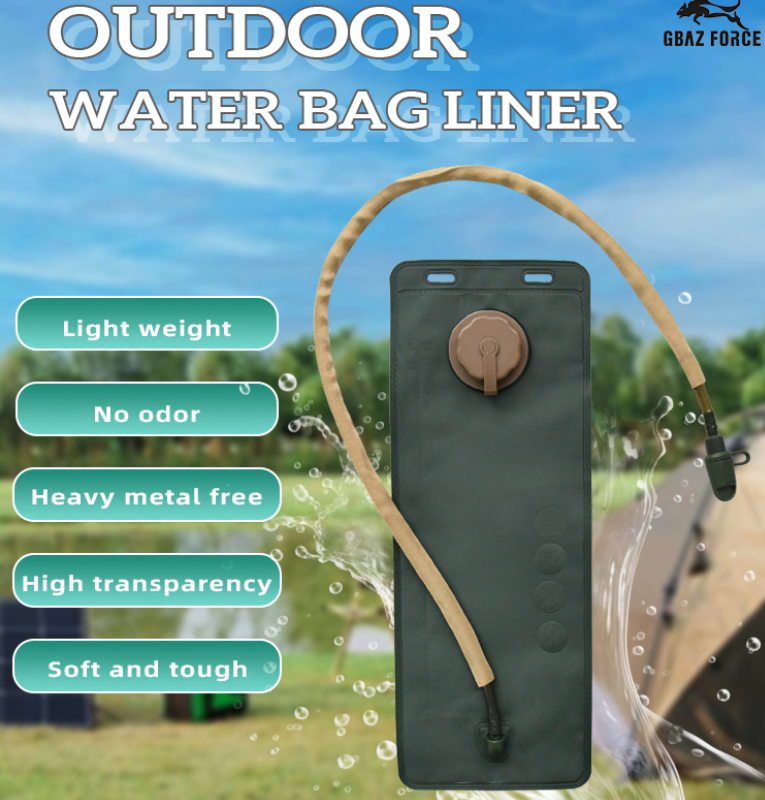
- Liner features. Our liner is quoted as light weight, odour-free, heavy-metal-free, highly transparent and soft yet tough — ask for those in writing.
- Weight. The insert is light by design; if it is not, you are carrying water you did not need.
Why brands source hydration from us
GAF OUTDOOR has 10+ years of OEM/ODM experience and 50+ brand customers in the US, Europe and Australia, from a 3,300 ㎡ plant with 20 production lines and 350+ staff. Bladders, bottle pouches and hydration sleeves run on the same nylon, hardware and colour library as our packs — sample in 7–15 days, custom OEM from 300 pcs per style, branding an existing design from 50 pcs.
Next step: see the hunting accessories range, or send your pack's sleeve size and we will match the bladder.
Short answer: A hunting meat bag is a lightweight, washable sack for carrying quartered game out of the field. It keeps meat clean and away from your back, and organises the load on a frame pack's load shelf. Our range runs two directions — a 34 L / 70 L drawstring bag and a 10 L / 20 L zipped bag — in nylon, weighing 0.11–0.17 kg each.
What the bag actually does
- Hygiene and cooling. Meat travels in its own clean sack, not against a pack that has been in the truck bed all season, and a loose bag lets a quarter cool as you walk.
- Load organisation. On a load shelf, it turns a shapeless quarter into a balanced load.
- Keeps your pack usable. Blood and fat stay out of the pack body, so the same frame pack carries your camp the next morning — and two bags weigh under half a kilogram between them.
Size and spec
| Model | Capacity | Dimensions | Weight | Closure | Fabric |
|---|---|---|---|---|---|
| 905-40 | 34 L | 28.3 × 16.9 in (72 × 43 cm) | 0.11 kg | Drawstring | Nylon |
| 905-40 | 70 L | 39 × 22 in (99 × 56 cm) | 0.17 kg | Drawstring | Nylon |
| 905-41 | 10 L | 18 × 7.1 in (45.7 × 18 cm) | 0.12 kg | YKK zip, 5 in flap | Nylon |
| 905-41 | 20 L | 22.4 × 10.2 in (57 × 26 cm) | 0.13 kg | YKK zip, 5.5 in flap | Nylon |
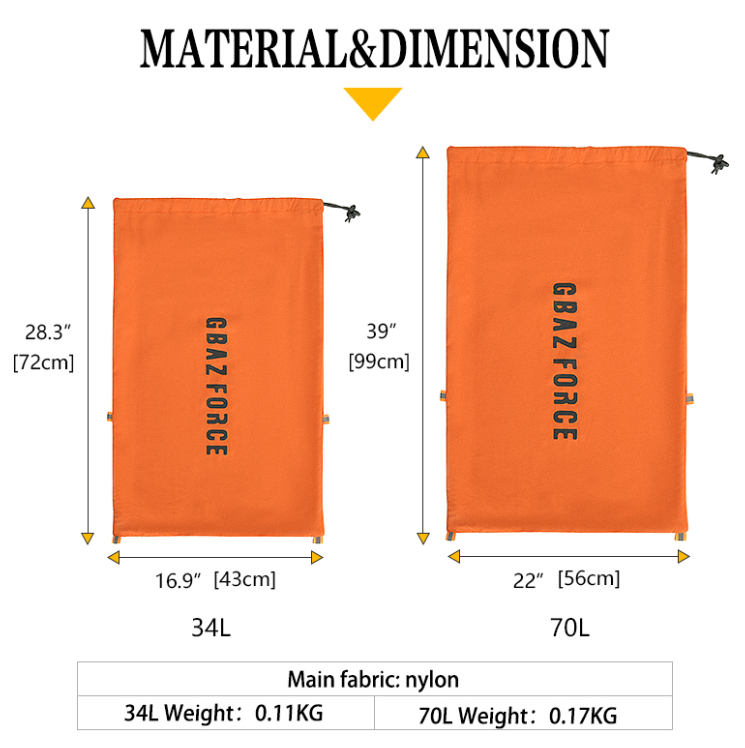
Which size you need
- 10 L / 20 L — boned-out meat from a deer, or one smaller quarter. Good when the bag rides inside a pack and is only filled at the end.
- 34 L — a full quarter from a deer, or a smaller elk quarter.
- 70 L — a whole deboned animal, or a pack-out where you want one load per trip instead of three.
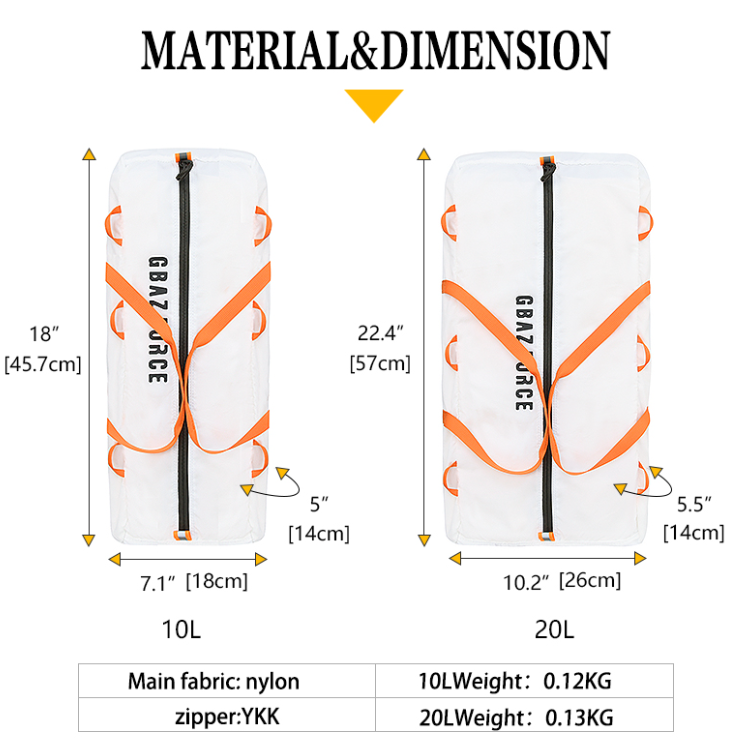
What to check before you buy or specify
- Closure type. A drawstring is faster one-handed in the dark; a YKK zip with a flap holds a shape and stays closed in a pack.
- Attachment points. Look for webbing loops or buckles so the bag ties down to a load shelf instead of shifting.
- Weight against capacity. A 70 L bag at 0.17 kg is the point — you are already carrying the meat.
- Visibility. A high-visibility orange option helps you track a bag in deep cover or after dark.
Why brands source bags from us
A meat bag only works if the pack can carry it, so we build both: our lightweight aluminium frame pack is quoted with a 150 lb / 68 kg meat bag and a load shelf, and a game bag pocket is a standard structural position across the range. GAF OUTDOOR has 10+ years of OEM/ODM experience and 50+ brand customers in the US, Europe and Australia, from a 3,300 ㎡ plant with 20 production lines and 350+ staff. Bags use the same nylon, YKK hardware and camo library as our packs — sample in 7–15 days, custom OEM from 300 pcs per style, branding an existing design from 50 pcs.
Next step: see the hunting accessories range, or send your target capacity and closure type and we will match the model.
Short answer: Choose on three points. How you carry — a plain webbing strap is enough for the walk from the truck, a padded sling is for full days on foot, and a wide padded sling is for a heavy rifle. How it attaches — sling swivel studs, quick-detach push-button swivels, or a clip. And how quiet it stays — soft webbing and foam instead of loose hardware knocking the stock. Our range runs 14 models, GS-001 to GS-014, and the GS-001 is rated to 300+ lb / 136+ kg.
The decisions, in order
| Decision | Options | Pick it when |
|---|---|---|
| Carry style | Plain webbing strap | Short walks, truck to stand |
| Padded sling | A full day on foot with a scoped rifle | |
| Wide padded sling | Heavy rifle, long distances, steep ground | |
| Attachment | Sling swivel studs | You want it fitted and left alone |
| Quick-detach push-button swivel | You swap the sling between rifles | |
| Clip-on loop | Retrofit without drilling or swivels | |
| Pad backing | Non-slip textured foam | Almost always — a slipping sling is the main complaint on a long carry |
| Colour | Camo, solid black, khaki/coyote | Match the rifle and the rest of your line |
| Branding | Embroidered logo | You are building your own brand |
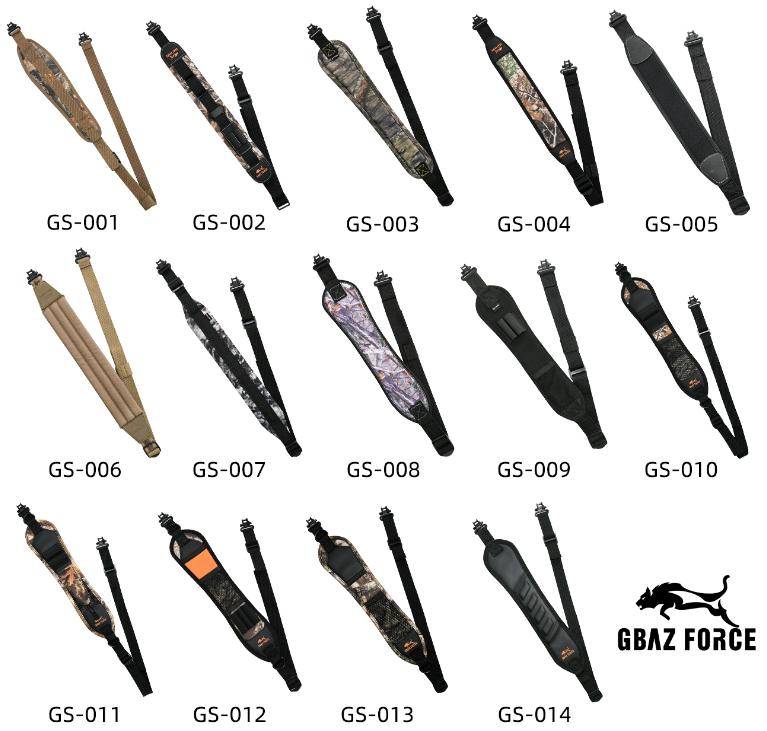
Six things to check
- Load rating. Ask for it in kilograms or pounds and get it in writing; the GS-001 carries a 300+ lb / 136+ kg rating.
- Foam and a non-slip backing. Low-density foam spreads the weight; a textured back pane stops the sling creeping off the shoulder.
- Adjustment range and buckle. A single easy-adjust buckle is faster to set than two sliders, and it holds better.
- Hardware noise. Metal swivels that rattle against the stock undo the point of a quiet hunting rig.
- Swivel compatibility. Check the stud or QD socket on your rifle before ordering, and confirm the swivel size.
- Width versus bulk. Wider is more comfortable and more to carry; match it to the rifle, not the catalogue photo.
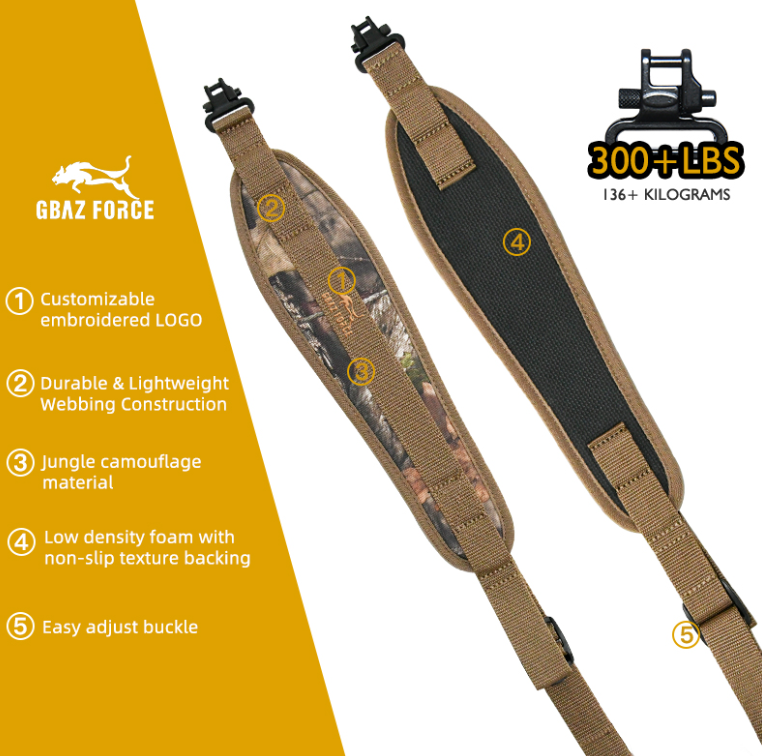
What we build
The sling line covers GS-001 to GS-014, plus the HX series. The GS-001 is the reference build: jungle camouflage material, durable lightweight webbing, low-density foam with a non-slip texture back pane, an easy-adjust buckle, and your logo embroidered on the pad. Camo, solid black and khaki colourways run across the range, with mesh and padded variants and a blaze-orange panel on one model.
Why brands source slings from us
GAF OUTDOOR has 10+ years of OEM/ODM experience and 50+ brand customers in the US, Europe and Australia, from a 3,300 ㎡ plant with 20 production lines and 350+ staff. Slings use the same camo library and hardware as our packs and cases — sample in 7–15 days, custom OEM from 300 pcs per style, branding an existing design from 50 pcs.
Next step: see the hunting accessories range, or send your rifle's swivel type and colour and we will match the model.
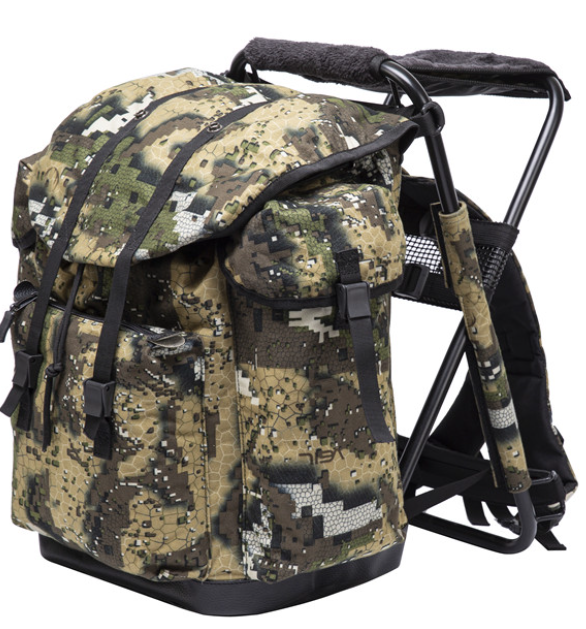
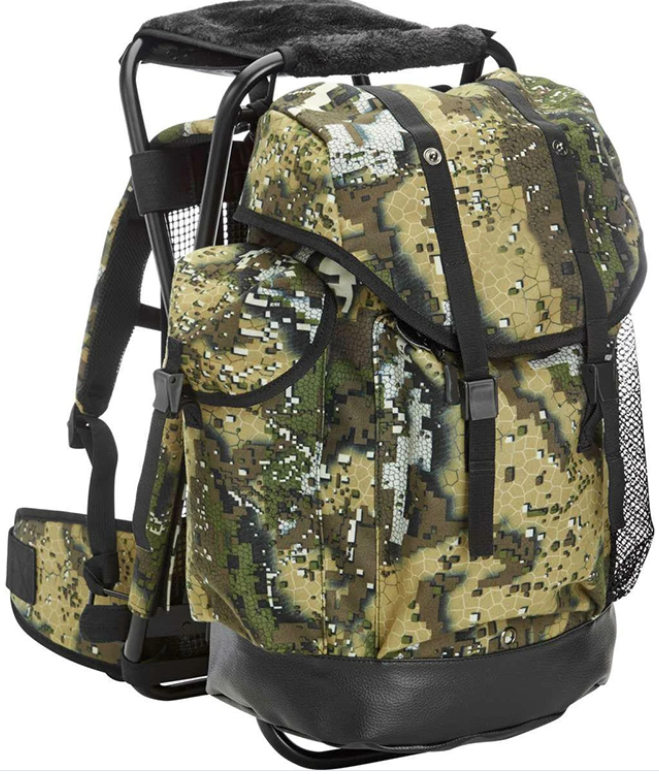
Short answer: A hunting stool pack — also called a chair pack — is a rucksack with a folding metal seat frame built into it. You carry your gear on your back, and when you reach the stand you sit on the pack. It is the standing answer to European driven hunts and long ground sits: one load instead of two, and no separate stool left behind in the truck. Capacity runs 25–30 L, and the seat frame on our 30 L model is rated to 120 kg.
Stool pack vs the alternatives
| Stool pack | Folding stool + daypack | Tree-stand seat | |
|---|---|---|---|
| What you carry | One item | Two items to manage | Seat stays on the stand |
| Seat frame | Integral, folding metal | Separate and loose | Fixed |
| Gun rest | Included on our 30 L model | No | Sometimes integrated |
| Capacity | 25–30 L | Whatever the pack holds | — |
| Best for | Driven hunts, long ground sits | Static hunts near the truck | Elevated stands |
The line at a glance
| Model | Capacity | Seat frame | Build |
|---|---|---|---|
| 30 L chair pack | 30 L | Detachable metal, 120 kg rated | Brushed quiet shell, includes gun rest |
| 905-014 | 25 L | Built-in seat | 500D nylon, waterproof |
| 1991 / 1992 / 905-013 / 905-015 | — | Folding frame | Camo shells, padded waist belt |
A detachable frame folds flatter for shipping and can be replaced without replacing the bag.
What to check before buying or specifying
- The rated load on the seat frame. Ask for the figure in kilograms. 120 kg is what makes a frame safe for a heavy hunter in winter clothing.
- Detachable or fixed frame. Detachable ships flatter and is serviceable.
- A gun rest. On a driven hunt the rifle is in your hands for hours; a rest built into the frame is worth more than another pocket.
- Quiet fabric. Rustle gives you away — brushed shells are the quietest option, with waterproof 500D nylon when weather is the bigger risk.
- Waist belt and back panel. You are carrying the pack and the frame, so a padded belt and a ventilated back panel decide whether hour four is comfortable.
Who needs one
Driven hunts with a stand number, roe and red deer stalking with long glassing sessions, and any ground hunt where you sit for hours in one spot. If you walk for miles and rarely sit, a plain day pack is lighter; if you sit more than you walk, the stool pack wins.
Why brands source them from us
GAF OUTDOOR has 10+ years of OEM/ODM experience and 50+ brand customers in the US, Europe and Australia, from a 3,300 ㎡ plant with 20 production lines and 350+ staff. Stool packs use the same quiet shells, camo library and hardware as our day packs — sample in 7–15 days, custom OEM from 300 pcs per style, branding an existing design from 50 pcs.
Next step: see the 905-014 25L stool pack, or send your seat height and load requirement and we will match the model.
Short answer: A hunting vest is a sleeveless carry system worn over a shirt or jacket that keeps the gear you reach for constantly — shells, calls, a rangefinder, water — on your chest and waist, and puts what you harvest in a rear game bag. The three types are the turkey vest, the upland or bird vest, and the general-purpose hunting vest. Capacity runs from a few pockets to a 25 L rear pack panel.
The three types
| Turkey vest | Upland / bird vest | General hunting vest | |
|---|---|---|---|
| Main job | Long sits in one spot | Walking up birds | Layering plus gear |
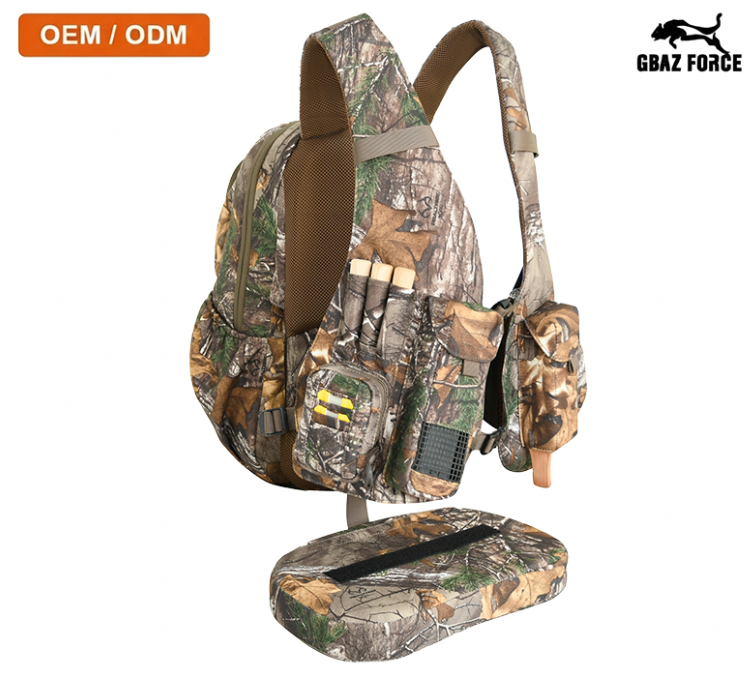
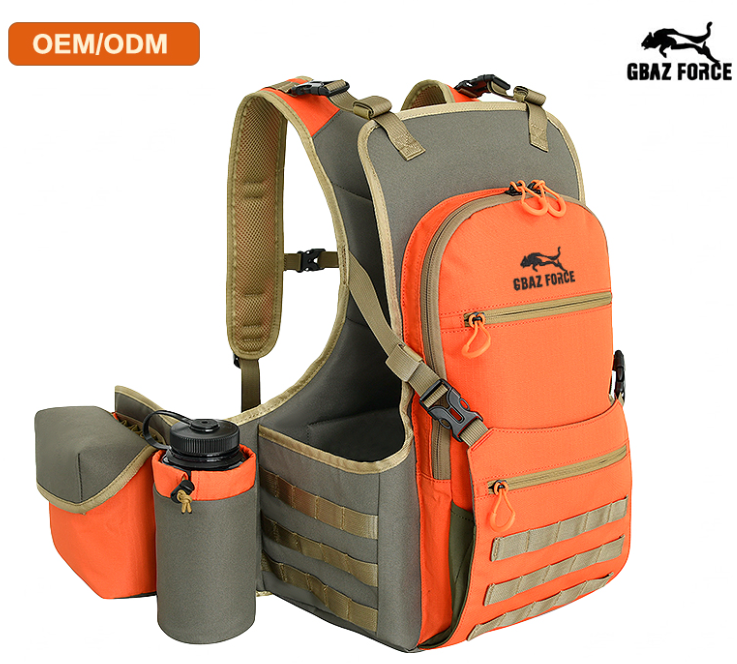
| Signature feature | Detachable seat cushion, call pockets | Front-access game bag, blaze orange | Chest and waist pockets |
| Capacity | 25 L rear pack | Pockets plus game bag | Light to moderate |
| Water | Bottle sleeve | Bottle sleeve and MOLLE | Hydration compatible |
| Our models | 905-054 (25 L) | 905-063 | 901-23, GA-TV-01 |
What a vest should carry
- Shell loops or a shell pouch within reach of your reloading hand.
- Dedicated call pockets, so a slate and a box call are not fighting for the same space.
- A rangefinder or GPS pocket on the chest, where you can reach it while sitting down.
- A rear game bag, front-access if you walk — that is what keeps a bird cool and out of your hands.
- A detachable seat cushion. On the 905-054 it is 5 cm thick and unclips instantly, which is what makes a long sit workable.
- Water. A bottle sleeve or hydration sleeve beats a bottle loose in a coat pocket.
- Blaze orange panels for upland seasons that require visibility.
Fit and construction notes
A vest is worn over layers, so the harness has to adjust across a heavy jacket as well as a shirt — buckle-adjustable shoulder straps rather than fixed webbing. Look for mesh where the vest meets your back, and check that the game bag drains: a wet bird left in a sealed compartment is the fastest way to spoil a hunt.
In production terms a vest is a small order item — fewer panels than a pack, but more hardware and pockets per unit — which makes the pocket layout the single biggest decision in the technical pack.
Why brands source vests from us
GAF OUTDOOR has 10+ years of OEM/ODM experience and 50+ brand customers in the US, Europe and Australia, from a 3,300 ㎡ plant with 20 production lines and 350+ staff. Vests run on the same camo library, MOLLE webbing and hardware as our packs — sample in 7–15 days, custom OEM from 300 pcs, branding an existing design from 50 pcs.
Next step: see the hunting vest range, or send your pocket layout and target species for a spec and quote.
july