loading

Professional Hunting Gear Manufacturer & Tactical Gear Supplier Since 2013

Can Hunting Backpacks Be Customized for Specific Markets (US, Europe, Australia)?

2026-10-07

Short answer: Yes. Hunting gear is regional, and we build to the market rather than to one global specification. US buyers generally want larger frame packs, tree-stand friendly day packs and licensed camo. Europe favours muted olive and brown, driven-hunt stool packs and moderate volumes. Australia leans lighter, with hot-climate build details and drab green patterns. Logistics run FOB Shenzhen / Guangzhou, or DDP to your door.

How the specification changes by market

United States Europe Australia
Typical volume 30–45 L day, 65–85 L pack-out 20–35 L day, stool packs, 30–50 L 35–50 L, multi-day
Colour and camo Realtree, Next Camo, ABT, Prym1 Olive, brown, grey-green, subtle patterns Dark green, brown, drab solids
Extra requirements Hunter-orange visibility options, rifle scabbard and bow carrier Quiet build for driven hunts, seat-integrated stool packs Lighter hardware, faster-drying liners and mesh
Frame Carbon or aluminium external frame Aluminium and carbon, moderate volumes Carbon and light aluminium
Order pattern Larger recurring volumes Smaller runs, more colour depth Broad size range per order

Logistics, packing and documentation

  • Terms. FOB Shenzhen / Guangzhou, or DDP door-to-door into the US, EU and Australia.
  • Shipping. Air, sea or express, matched to your season rather than to convenience.
  • Channel packing. Amazon FBA-ready cartons and labels, or your own retail packing.
  • Documentation. Material specifications and, where your market requires it, chemical-compliance declarations for the fabrics and coatings specified on the order.
  • Sampling. A physical sample goes out before production, so the market test happens on the real product rather than on a photo.
Can Hunting Backpacks Be Customized for Specific Markets (US, Europe, Australia)? 1
GAF OUTDOOR global shipping — air, sea and express consignments via FedEx, DHL, UPS, TNT and EMS

Two worked examples

A US brand launching an elk line. 80 L and 65 L carbon-frame packs with side rifle scabbards, licensed camo, hunter-orange visibility options on the day packs, and FBA-ready cartons. Volume sits at the pack-out end of the range, and the pack still has to be quiet enough to hunt with.

A European retailer refreshing a driven-hunt range. 30 L and 45 L packs in muted olive and brown, a seat-integrated stool pack, brushed faces throughout, and smaller runs spread across more colourways. The priority is quietness and a palette that sells from a shop shelf, not from a catalogue photograph.

Both projects run through the same design, sampling and inspection process — only the specification changes.

Why one factory can serve all three markets

Every difference above is a pattern, fabric or colour decision, and all of them are settled in the technical pack before sampling begins. Because we keep both a quiet brushed-tricot line and a nylon / Cordura line in house, a US pack-out build and a European driven-hunt pack can be developed in parallel without splitting your supply base or your approval calendar.

Next step: tell us your target market and we will send the standard specification we build for that region.
prev
How Do I Choose a Reliable Hunting Backpack Manufacturer in China?
Related questions
1
How Do I Choose a Reliable Hunting Backpack Manufacturer in China?

Short answer: Judge a Chinese hunting backpack manufacturer on six things: whether they are a factory or a trader, their capacity and equipment, their quality process and inspection records, their sampling speed, their camo and hardware capability, and their communication discipline. Ask every candidate for the same evidence on each point, and the field narrows quickly.

The six checks

Check What to ask What a good answer looks like
Factory or trader Which address actually cuts the fabric? A named plant, a production line list, real equipment photos
Capacity Monthly output, lines, operators, designers Numbers that match across website, profile and quotation
Quality Who inspects, at which step, with what record? Named QC staff, in-line and final inspection, traceable records
Sampling How fast, how many revisions, who draws the pattern? 7–15 days, in-house pattern making, a free tech pack
Materials Fabric library, camo options, hardware brands A specified fabric range and licensed camo capability
Communication Reply time, single point of contact, English documents A committed response window and written specifications

Red flags

  • Capacity numbers that change between the website, the company profile and the quotation.
  • No physical sample until a deposit has cleared.
  • "We can do anything" — with no technical pack, no fabric list and no camo references behind it.
  • Certificates offered without an original carrying the factory's own legal name.
  • A quality process described only as "we check everything".

Three questions that end the conversation quickly

Ask for the six-step production flow, the inspection record from a recent order, and the brand name of the zipper and buckle supplier. A factory answers all three in a single reply. A trader forwards the question to somebody else and answers in a week.


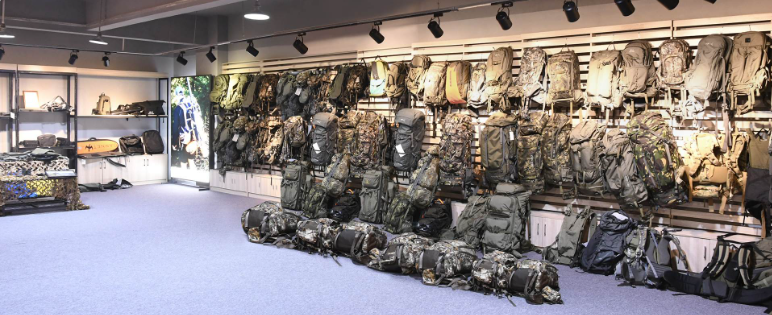
GAF OUTDOOR showroom in Guangzhou — hunting packs and frame packs on display, where buyers review samples in person

How to verify a factory without flying there

  • Video walk-through. Ask for a live call through the cutting floor and the sample room, not a download of edited footage.
  • Order the sample. A physical sample is the cheapest audit available; it shows the stitch density and hardware quality in a size you can feel.
  • Ask for one recent inspection record and one recent packing list. Paperwork with dates, quantities and signatures is difficult to construct after the fact.
  • Check the equipment list against the product. Frame packs need high-head and heavy-duty machines; a plant without them cannot make one properly.

How we answer these questions

We are a Guangzhou-based hunting backpack manufacturer with in-house cutting, sewing, pattern making, an in-house testing lab and a dedicated sampling room. Our facility covers 3,300 ㎡ across 20 production lines with 350+ staff, producing 30,000–50,000 backpacks a month for buyers in the US, Europe and Australia. Production follows a documented six-step flow from fabric inspection to packing, with in-line and pre-shipment inspection, dedicated QA/QC inspectors and material traceability from incoming roll to packed carton. Third-party inspection by your nominated agency is welcome, and we will answer the checklist above line by line, in writing.

Next step: send us the checklist above and we will respond against every point.

2
Do You Offer Wholesale Hunting Backpacks for Distributors and Outdoor Brands?

Short answer: Yes. We supply hunting backpacks wholesale to distributors, outdoor retailers and brand owners on two routes: branded stock programmes from 50 pieces with fast delivery, and full OEM/ODM runs from 300 pieces built to your own design. A large ready-to-ship inventory supports short-notice replenishment, and packing can be configured for Amazon FBA or your own retail cartons.

Two wholesale routes

Branded stock programme Custom OEM/ODM
Minimum 50 pcs 300 pcs per style
Product An existing design with your logo, labels and hangtags Your design, construction, colours and camo
Lead time Fast, from existing inventory 45–65 days after sample approval
Best for Retailers and distributors testing or replenishing Brands building an exclusive line
Packing Polybag, hangtag, retail or FBA carton Fully specified to your requirement

What a wholesale account includes

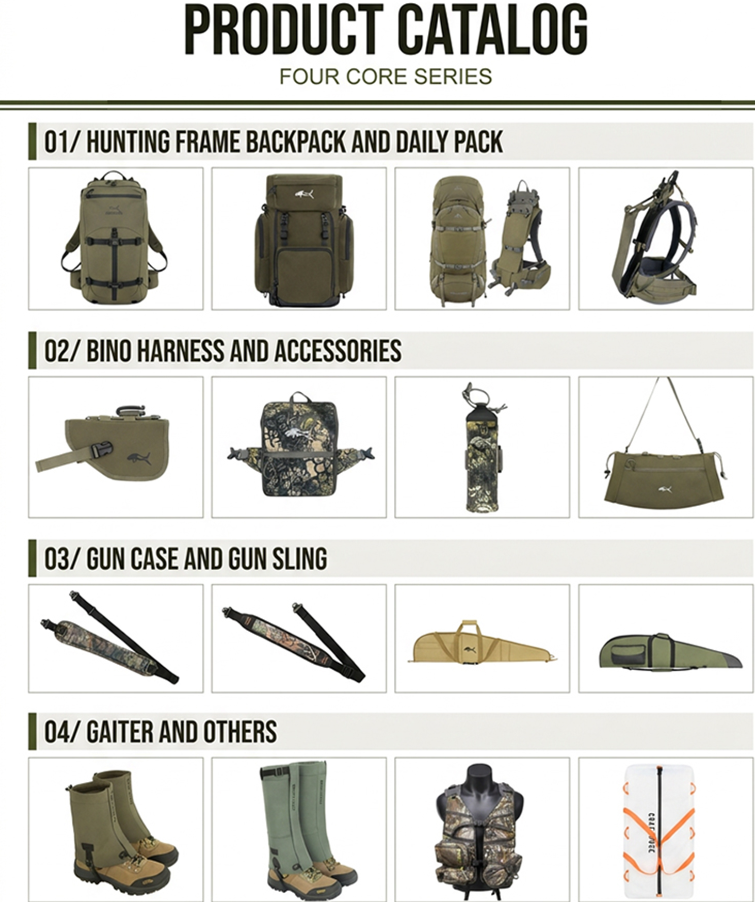
  • A one-stop range. Hunting frame packs and daily packs, bino harnesses and chest packs, rifle cases and slings, gaiters, vests, meat bags, waterproof packs and hydration.
  • Commercial documentation. Quotation, technical pack, packing list and inspection record for each order.
  • Terms. T/T 30% deposit + 70% before shipment, or Trade Assurance. FOB Shenzhen / Guangzhou, or DDP to your door.
  • After-sales cover. A 12-month warranty on stitching and zippers, with replacement parts supplied free of charge.
  • Brand support. Product photography, video and marketing material available alongside your order.

GAF OUTDOOR hunting product catalogue — four core series: hunting frame backpack and daily pack, bino harness and accessories, gun case and gun sling, gaiter and others

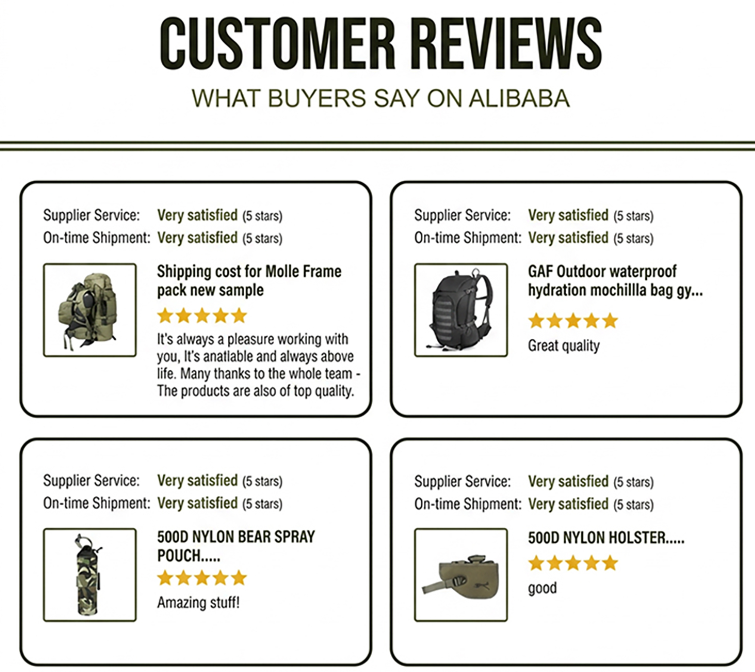
Five-star buyer reviews for GAF OUTDOOR packs — supplier service and on-time shipment

How to open a wholesale account

  • Tell us the range and the market. Category, target retail price band, and the volume you can commit to this season.
  • Take a sample. A physical sample of the pack you are considering, shipped before any order is placed.
  • Choose your route. Branded stock from 50 pcs for a fast, low-risk start, or a 300-piece OEM run for an exclusive line.
  • Confirm packing and terms. Retail carton, hangtag and labelling specification, plus FOB or DDP delivery.
  • Repeat with confidence. The inspection record from the first order becomes the baseline for the second.

Why distributors stay with us

Buyers come back for three reasons: a minimum order that lets them test a market without risking a container, a quoted lead time they can plan a season around, and an inspection process that means the second order matches the first. That combination — not the lowest unit price — is what keeps a wholesale relationship running past the first season.

Scale matters too, and it goes both ways. Our Guangzhou plant covers 3,300 ㎡ with 20 production lines and 350+ staff, cutting and sewing 30,000–50,000 backpacks a month, so a 50-piece trial order and a 5,000-piece seasonal programme sit on the same schedule and the same QC process.

Next step: send your target category, volumes and market and we will return a wholesale price list.

3
What Materials Are Used in Your Hunting Backpacks (Fabric, Frame and Quiet Hardware)?

Short answer: Our hunting backpacks use brushed tricot or 500D / 1000D nylon and 500D Cordura for the shell, carbon fibre or aluminium external frames for load carriage, and YKK zippers with Duraflex buckles for hardware. Brushed outer faces and low-silence zipper pulls keep the pack quiet in the field. Every material is chosen against three criteria: quietness, abrasion resistance and weight.

Fabric library

Fabric Where it is used Why it is specified
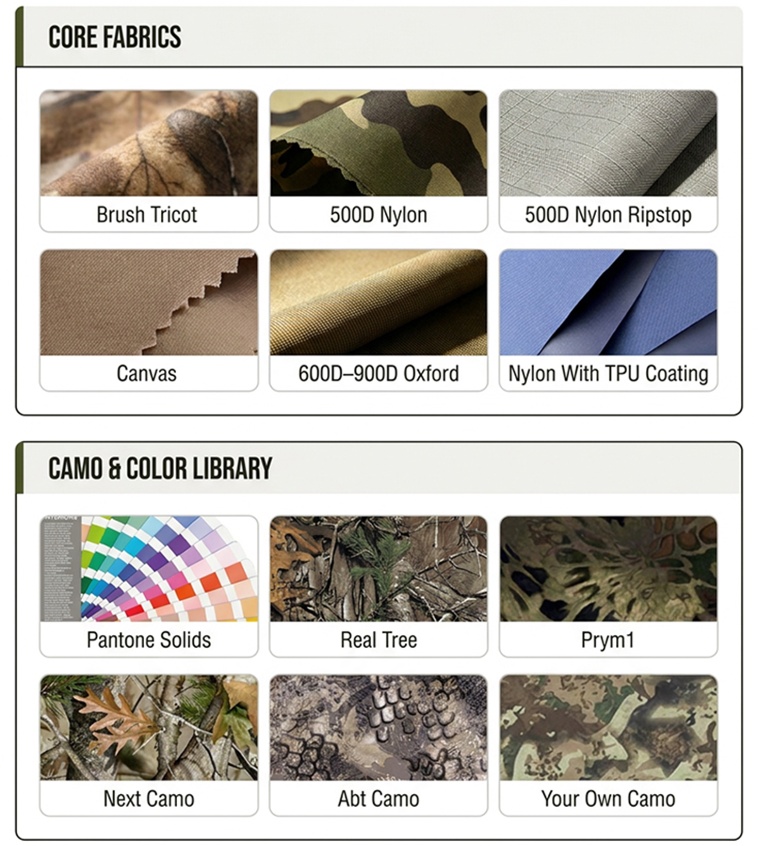
Brushed tricot Outer face of quiet packs and bino harnesses Absorbs surface rustle; the quietest option we offer
500D nylon Main body of most hunting packs Best balance of weight and abrasion resistance
500D nylon ripstop Lightweight panels and liners Stops a tear from spreading
500D Cordura Frame packs, gun cases, high-wear bodies Highest abrasion resistance in the range
1000D nylon Reinforced trim and heavy-duty panels Maximum durability where abrasion is worst
600D–900D oxford Gun cases and value models Cost-effective toughness
Nylon with TPU coating Waterproof bodies and dry bags Sealed, two-sided weather protection
210D polyester + DWR Linings Stops internal moisture from spreading

GAF OUTDOOR fabric library — brushed tricot, 500D nylon and ripstop, Cordura, oxford and TPU-coated nylon, with the camo and colour library

Frames and load carriage

  • Carbon fibre frame — the lightest option, used on our high-end frame packs, and the one a hunter notices at hour eight.
  • Aluminium external frame — a higher strength-to-cost ratio, standard for value frame packs and heavy pack-outs.
  • Load shelf and meat bag — the interfaces that let a frame pack carry an animal quarter, rated to 150 lb / 68 kg on our lightweight aluminium model.

Quiet hardware

Noise is a material decision, not a sticker. A brushed face removes the rustle of a woven shell, and low-silence zipper pulls remove the second loudest sound a pack makes. Brushed-face builds measure roughly 30% quieter than an equivalent standard nylon build, with zipper operation below 40 dB. Buckles are Duraflex or assessed local equivalents, and the buckles plus roll-locks are the components that take the real load — which is why they are an inspection point in every order.


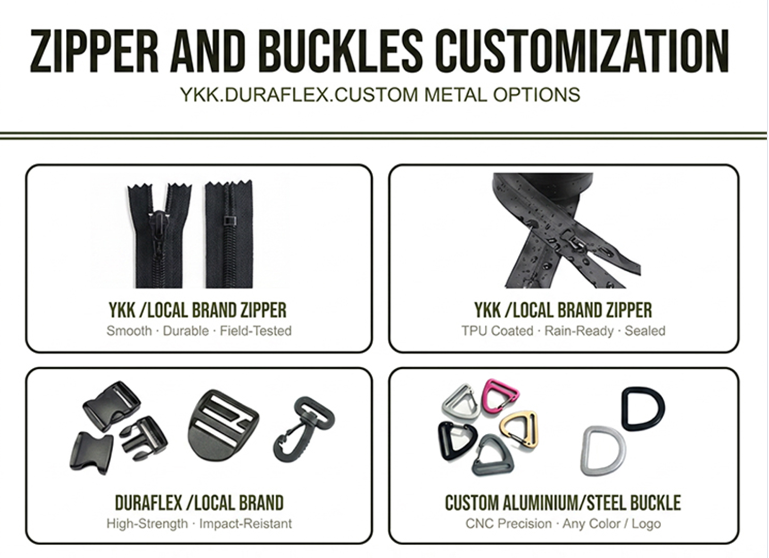
GAF OUTDOOR zipper and buckle customisation — YKK and TPU-coated waterproof zippers, Duraflex buckles, CNC aluminium and steel hardware

Making the materials last

Two habits extend the life of a hunting pack more than any specification: keep the frame, buckles and zipper sliders clean of grit, and dry the pack open and unloaded rather than storing it compressed. Abrasion and UV exposure age every coating and fabric eventually, and checking the high-wear points — the base, the corners, the scabbard opening — once a season catches a repair before it becomes a replacement.

Where this gets written down for you

Every element above is a line item in your technical pack, so fabric, frame and hardware can be traded against cost, weight or quietness on a documented basis rather than a verbal one. That is what makes a specification repeatable from the first order to the fifth.

Next step: ask for the material specification for the model you are considering, or for the frame platform you want to build on.

4
Can You OEM Hunting Backpacks With Our Own Design, Logo and Camo Pattern?

Short answer: Yes. We build hunting backpacks to your design, your physical sample, or a design from our catalogue, with your logo, your colours and your camo. Custom OEM/ODM runs at 300 pieces per style; branding an existing design starts at 50 pieces. Camouflage fabric printed with your own pattern has a 1,000-yard fabric minimum, and we can help you apply for licensed patterns such as Realtree.

What you can specify

Element Options
Development route Your drawings, your physical sample, or a catalogue design to be modified
Structure Volume, pocket layout, frame type, load shelf, rifle scabbard, bow carrier, hydration sleeve
Fabric 500D / 1000D nylon, 500D Cordura, ripstop, brushed tricot, 600D–900D oxford, TPU-coated nylon
Camo Realtree, Next Camo, ABT Camo, Prym1, Mossy Oak, plus your own camo
Solid colour Pantone-matched dyed fabric
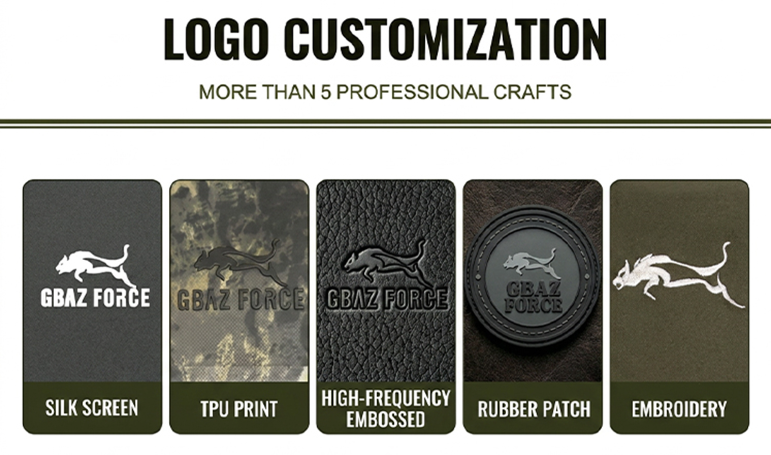
Logo craft Silk screen, TPU print, high-frequency embossed, rubber patch, embroidery
Hardware YKK zippers, TPU-coated waterproof zippers, Duraflex buckles, CNC aluminium or stainless buckles in any colour, logo-engraved
Packing Polybag, hangtag, retail carton, Amazon FBA-ready packing

GAF OUTDOOR logo customisation — five crafts: silk screen, TPU print, high-frequency embossed, rubber patch and embroidery

How the design stage works

Send a drawing, a sketch, a sample, or reference photography with the changes you want. Our design team returns a free pattern drawing and technical pack for your comment before sampling begins, so you approve the construction — not just a picture of it. Samples then follow in 7–15 days, and bulk production runs 45–65 days after approval.

A custom programme, stage by stage

Stage Time Your input Our output
Design 3–7 days Sketch, sample or reference Pattern drawing and technical pack
Sample 7–15 days Approval comments Physical sample with your camo and logo
Production 45–65 days Deposit and packing specification Finished order with inspection record
Shipping Per your terms Forwarder or DDP instruction FOB Shenzhen / Guangzhou or door delivery

Protecting your design

Exclusive styles stay exclusive. Your patterns and technical packs are not reused for other customers, and your camo or colour story is not offered to another brand on the same market. Confidentiality works in the other direction too: if a design of ours inspires yours, we will tell you which parts are free to use and which are licensed.

Why brands develop with us

We are a hunting backpack specialist, not a general bag factory with a hunting page. The whole range — frame packs, daily packs, bino harnesses, gun cases and slings, gaiters and vests — runs on one brand standard, one QC process and one shipping schedule, so a full season's launch stays on a single calendar. Our Guangzhou plant holds 20 production lines and 350+ staff across 3,300 ㎡, with an in-house design team that draws your pattern before the first sample is cut.

Next step: send your design or chosen model and we will return a technical pack and a sampling quote.

5
What Capacity Hunting Backpack Do I Need for Day Hunts vs Multi-Day Trips?

Short answer: For a single-day hunt, choose 20–35 L. For a long day, or a day that may end in a pack-out, choose 35–45 L. For two to four days out of a vehicle or a base camp, choose 65 L. For backpack hunts, fly-in trips and big-game pack-outs, choose 80 L or more. The deciding factor is not the number of days — it is whether you have to carry camp and an animal as well as your gear.

Capacity by trip type

Trip Volume Carries Model class
Tree stand / blind day hunt 13–25 L Layers, calls, food, water, optics 905-023 13L, 905-024 25L, 905-029 20L
Full day on foot 30–36 L Adds rain shell, first aid, extra water 901-08 30L, 905-047 36L
Long day with pack-out risk 35–45 L Adds a load shelf or meat bag 905-052 35L, 905-061 45L
2–4 days from camp 50–65 L Sleeping bag, stove, spare clothing 901-09 50L, 1932 65L, 905-030 65L
Backpack hunt / fly-in 80–85 L+ Camp plus an animal quarter 1931 80L, 905-031 85L

The four rules that matter more than the number

  • Meat changes everything. A single elk quarter weighs roughly 25–35 kg. Only a frame pack with a rigid frame, a load shelf and a real hip belt is designed to carry that out over broken ground.
  • Volume is not weight. A 45 L pack loaded to 20 kg is harder work than an 80 L pack at 15 kg. Match the pack to the load, not to the length of the trip.
  • Winter layers occupy volume fast. A load that fits comfortably in 35 L in October can need 50 L in January. Down and thick wool fill a bag quickly.
  • Smaller is quieter and handier. In timber and heavy brush, a 30 L pack clears branches and rides closer to the back, which is exactly where you want it in poor light.

Size your load before you size the pack

Write the list down and weigh it. For a general day hunt on foot, the kit usually lands between 5 and 9 kg including water; a pack-out day adds an animal quarter at 25–35 kg. A 35 L pack handles the first comfortably. The second is a frame-and-hip-belt question, not a volume question — which is why hunters who regularly pack out step straight to a 65 L or 80 L frame platform even for single-day trips.


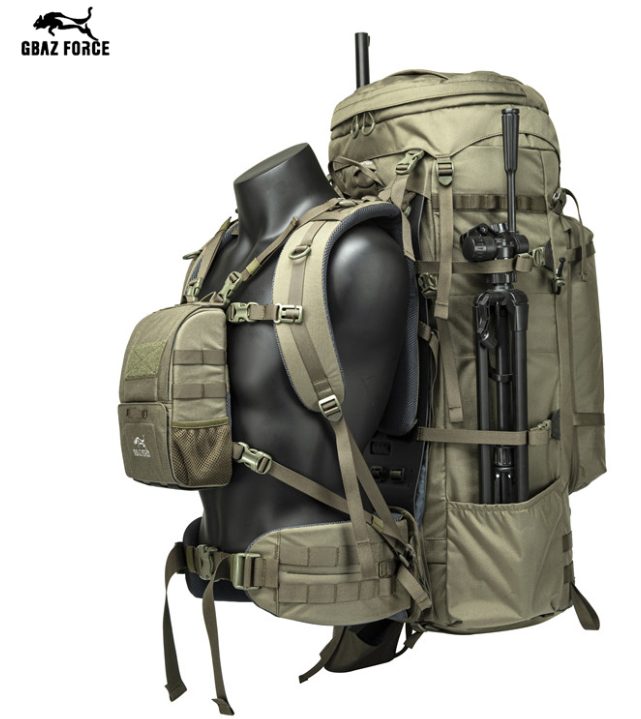
GAF OUTDOOR 1931 80L carbon-fibre frame pack with side rifle scabbard and modular bino pouch — built for multi-day hunts and pack-outs

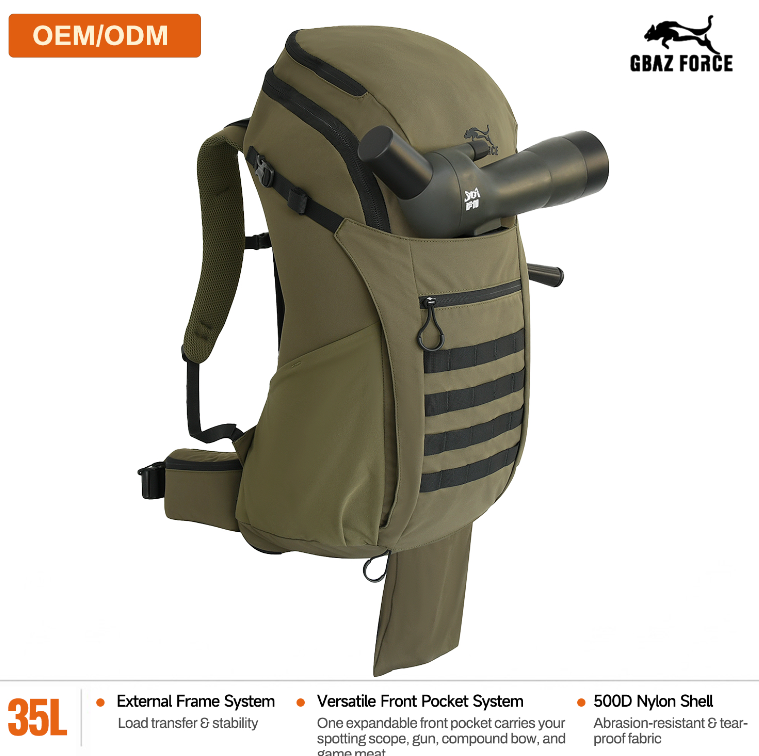
GAF OUTDOOR 905-052 35L external-frame hunting pack — front pocket sized for a spotting scope, MOLLE panel and 500D nylon shell

How we cover the whole capacity ladder

The frame platform behind our 20 / 45 / 65 / 85 L models is shared, so a brand can build a complete size family on one set of approvals instead of five separate developments. Carbon frames where weight matters most, aluminium external frames where value matters more, and 500D Cordura or 500D nylon shells across the range.

Next step: tell us the species, the terrain and whether you pack out and we will size the pack to the job.

6
What Is the Difference Between a Hunting Backpack and a Tactical Backpack?

Short answer: A hunting backpack is built to be quiet, camouflaged and load-bearing over distance, usually on an external frame that can also carry an animal out. A tactical backpack is built to be modular, abrasion-resistant and armour-compatible, usually in solid colours or military patterns, with MOLLE webbing and hydration or plate-carrier integration. The differences show up in four places: noise, colour, the frame, and the mounting system.

Side by side

Hunting backpack Tactical backpack
Primary job Carry gear and meat through rough terrain, unseen Carry equipment, plates or comms, modularly
Outer fabric Brushed tricot, 500D nylon, 500D Cordura, camo print 1000D nylon, ripstop, laser-cut laminate
Noise Brushed face and low-silence zips; operation under 40 dB Louder face, ripstop crackle, hook-and-loop tear
Colour Realtree, Next Camo, ABT, Prym1, own camo, Pantone solids Solid black, tan, ranger green, military patterns
Load carriage External carbon or aluminium frame, load shelf, meat bag Internal or none, often plate-carrier compatible
Modularity Silence-first: bino pouch, rifle scabbard, bow carrier MOLLE / PALS throughout: pouches, magazines, radios
Typical volume 20–45 L day, 65–85 L multi-day 12–35 L, plus assault packs
Best for Bow, rifle, elk, deer, turkey, waterfowl, driven hunts Range, training, law enforcement, security, field comms

Where the two designs trade off

Noise. A 1000D nylon face and a ripstop grid make a distinct rustle at exactly the moment a deer is inside 40 metres. A brushed tricot face on a hunting pack absorbs that surface noise, and low-silence zipper pulls remove the second loudest sound a pack makes.

Load. Tactical packs are generally sized to sit high and tight against armour. A hunting frame pack is sized to carry weight — including a quartered animal — with a load shelf, a rigid frame and a hip belt that transfers load to the hips.

Modularity. MOLLE is excellent for rigid, deliberate configurations. Hunting packs use it selectively and add purpose-built interfaces instead: a rifle scabbard, a bow carrier, a bino pouch, a game-call pocket.

What that means when you buy a hunting pack

Four specifications do the work, and they are the four to check on any pack you are considering:

  • A brushed outer face, not a ripstop grid — it is the single biggest noise difference you can buy.
  • Low-silence zipper pulls and closures, so the opening does not announce you at 40 metres.
  • A rigid frame plus a real hip belt, so an animal quarter transfers to your hips instead of your shoulders.
  • Hunting-specific interfaces — rifle scabbard, bow carrier, bino pouch, game-call pocket — instead of a wall of generic webbing.

GAF OUTDOOR 901-08 30L and 901-09 50L hunting backpacks in camo — the 30L covers tree-stand and day hunts, the 50L extends to long days and overnight loads

How we build for hunters

Every pack we make is designed around hunting rather than around a tactical specification with a camo print applied afterwards. That means brushed outer faces rather than ripstop crackle, aluminium or carbon frames and hip belts sized for an animal quarter rather than a plate, and attachment points chosen for the kit a hunter actually carries on the mountain. The range runs from 13 L day packs to 85 L frame packs, on one QC process and one shipping schedule.

Next step: tell us the hunt — species, terrain and carry weight — and we will recommend frame, volume and fabric.

GET IN TOUCH WITH Us
Add:
1# Shangjie Hehe Road Hecheng Shiling Town Huadu District Guangzhou City 510850 China
Contact person

july

Have any questions?
july-bags@foxmail.com
Call us
+86 13922517997
Follow us
Copyright © 2026 GAF | Sitemap
Customer service
detect