


What Size Rifle Case Do I Need for Hunting?
Short answer: Measure your rifle from the muzzle to the end of the buttstock — including any muzzle brake or suppressor — then add 2–3 inches. Cases in our range run from 44.5 to 52.8 inches inside, which covers a compact carbine through to a magnum bolt-action with a long brake. Then match the construction to the job: soft padded for the truck and the field, hard shell for airlines, welded waterproof for boat and waterfowl.
Inside length: what to pick
| Inside length | Models | Suits a rifle measuring up to |
|---|---|---|
| 44.5 in | GC-31, GC-38 | ~41 in overall — carbines, lever actions, youth rifles |
| 46.1 in | GC-09 | ~43 in — compact scoped bolt-actions |
| 47.2 in | GC-12, GC-21, GC-32, GC-33 | ~44 in — the standard scoped hunting rifle |
| 48.4 in | GC-25 | ~45 in — long-action bolt rifles with optics |
| 50.4 in | GC-17, GC-24, GC-34 | ~47 in — magnum barrels and rifles with brakes |
| 52.8 in | GC-08 | ~49 in — extra-long barrels and shotgun rigs |
How to measure
1. Fit the rifle the way you hunt it. Scope mounted, brake or suppressor fitted, sling attached. 2. Measure muzzle to buttstock, not barrel length. Barrel length tells you nothing about case size. 3. Add 2–3 inches. That margin is what stops a scope turret or a front sight from pressing into the end wall. 4. Check width and depth too. A large objective with tall turrets needs a case wide enough at the scope line, not just long enough.
Soft, hard or welded
| Soft padded case | Hard shell case | Welded waterproof case | |
|---|---|---|---|
| Protection | Padding against knocks and dust | Rigid shell against impact and crush | Sealed against water and mud |
| Weight | Light | Heavy | Light to moderate |
| Airline travel | Not recommended | The right choice for checked baggage | — |
| Weather | Water-resistant fabric | Weather-resistant | Fully sealed construction |
| Best for | Truck, blind, day hunts | Flying, long haul, high-value rigs | Boat, float trips, waterfowl, ATV |
| Typical build | 600D–900D oxford, foam lined | Padded walls, internal straps | TPU-welded panels, sealed seams |
Four features worth specifying
- Foam thickness where the receiver and scope rest, not just at the two ends.
- An internal tie-down or strap so the rifle cannot slide forward in transit.
- A full-length zipper with a storm flap on soft cases; a sealed closure on waterproof ones.
- Camo or solid colour, matched to the rest of your line.
Why brands source cases from us
GAF OUTDOOR has 10+ years of OEM/ODM experience and 50+ brand customers in the US, Europe and Australia, from a 3,300 ㎡ plant with 20 production lines and 350+ staff. The gun case line is our widest programme — 600D to 900D oxford, hard-shell and welded waterproof constructions, sharing the same camo and hardware library as our packs.
Next step: see the rifle case range, or send your rifle's overall length and we will match the model.
Short answer: Water-repellent means the fabric carries a DWR finish that makes rain bead and roll off, but the shell wets out and water can still pass through seams, zippers and stitch holes. Waterproof means the shell is coated or laminated and the seams are sealed, so water cannot pass — and with an IPX7 airtight zipper the pack survives immersion. Most hunting packs should be water-repellent; float trips and waterfowl need waterproof.
Three levels
| Water-repellent (DWR) | Waterproof (coated, sealed) | Submersible (IPX7 airtight) | |
|---|---|---|---|
| What it means | Rain beads off the face | Water cannot pass shell or seams | Sealed against temporary immersion |
| Zipper | Standard YKK coil | TPU-coated or AquaGuard zipper | IPX7 airtight and waterproof zipper |
| Seams | Sewn, not sealed | Sealed or taped at critical seams | Fully sealed, welded construction |
| River crossing or capsize | Not designed for it | Water may reach the zipper | Survives temporary immersion |
| Typical use | Day hunts, stalking | Multi-day hunts, wet climates | Float trips, waterfowl, boat access |
Why it matters on a hunt
- Optics and electronics are the first casualties: a wet rangefinder or phone ends the day.
- Multi-day rain and water access. A DWR finish wets out over hours and water migrates through stitch holes, so if you wade, cross or hunt from a boat, only a sealed pack is the right answer.
- Weight and noise trade off. Sealed zippers add weight, and the quietest brushed-tricot faces are usually water-repellent rather than sealed.
Five checks when you specify one
1. Coating type. Nylon with DWR plus PU is the value route; a DWR plus TPU bond is more durable and is what we use on quiet brushed faces. 2. Zipper class. A standard coil zip is not waterproof, a TPU-coated zip resists rain, and only IPX7 airtight survives immersion. 3. Seam treatment. Ask whether seams are sealed or taped, or only sewn. 4. Where the water gets in. Test the zipper line, the base and the strap attachment points. 5. The honest rating. Ask what the pack is rated for — rain, spray or immersion — in writing.
What we build
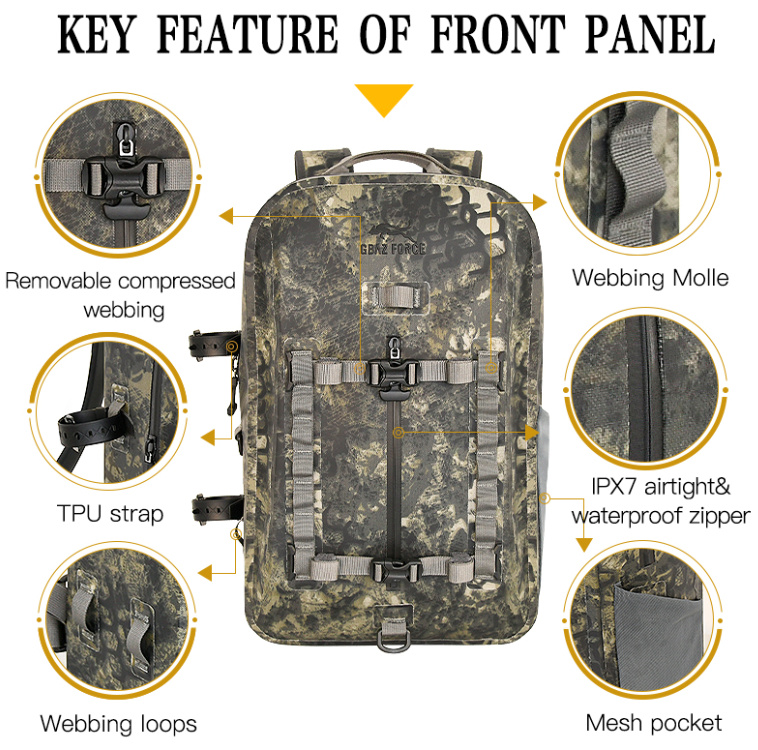
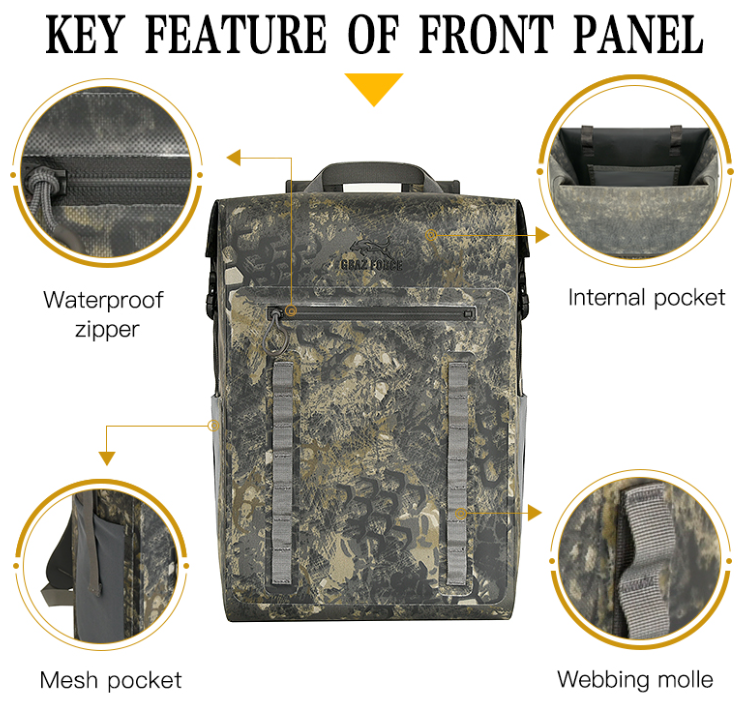
Our waterproof line covers all three levels. The 906-001 and 906-008 backpacks use an IPX7 airtight and waterproof zipper with TPU straps, webbing MOLLE and sealed panels, and the dry-bag programme adds 840D nylon TPU dry packs plus the 50L / 100L floating waterproof duffel. On the hunting side, nylon bodies are finished with DWR plus PU, and brushed-tricot quiet faces use a DWR with TPU bond — so a pack stays quiet and sheds weather.
Why brands source waterproof packs from us
GAF OUTDOOR has 10+ years of OEM/ODM experience and 50+ brand customers in the US, Europe and Australia, from a 3,300 ㎡ plant with 20 production lines and 350+ staff. Coating, zipper class and seam sealing are all fixed in the technical pack before sampling.
Next step: see the waterproof dry bag range, or send your water-exposure requirement and we will specify the coating, zipper and seam treatment.
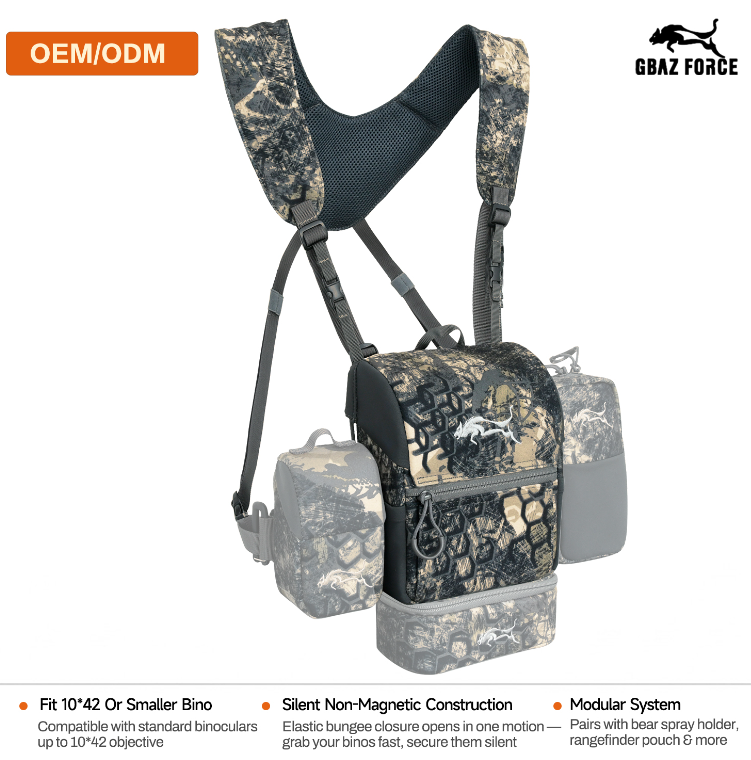
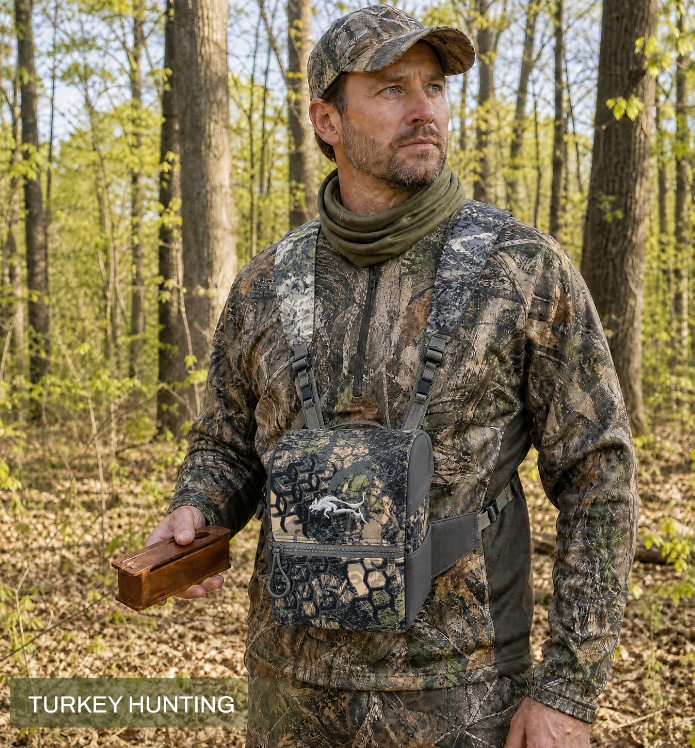
Short answer: A bino harness is a chest-mounted carrier that holds binoculars flat against your sternum on two shoulder straps, so your glass is always in reach and never swinging from your neck. Most hunting versions add a rangefinder pouch, call pocket or bear-spray holder, and the good ones open with a bungee closure rather than a zipper or hook-and-loop, so they stay silent.
Bino harness vs neck strap vs chest pack
| Bino harness | Neck strap | Chest pack | |
|---|---|---|---|
| Carry position | Chest, held flat against the sternum | Neck, free to swing | Chest, rigid box |
| Access | One-hand, one-motion bungee opening | Slow; arrives tangled | Unzip or flip lid |
| Noise | Silent with a bungee or elastic closure | Strap rub, binos knocking together | Zipper and hook-and-loop |
| Protection | Padded shell, DWR or TPU-coated face, rain cover | None | High — hard shell |
| Modularity | Rangefinder pouch, call pocket, bear spray, radio | None | Limited |
Why hunters wear one
- Access and silence. Glass at your chest is one small hand movement, and a bungee closure defeats the two loudest failures of a strap: rub and knock.
- Protection. Dust, rain and brush damage optics; a padded shell and a water-repellent face keep glass usable.
- Load balance and pack fit. Two straps over the shoulders beat weight on the neck, and the harness sits under backpack straps without fighting a rifle scabbard or bow sling.
Six checks before you buy or spec one
1. Bino size. Most are built around a 10×42 or smaller objective. Check the internal dimension, not the photo. 2. Closure type. A bungee or elastic closure opens in one motion and shuts silently. Avoid hook-and-loop near optics. 3. Face fabric. Brushed tricot absorbs surface rustle; woven nylon and ripstop do not. 4. Weather protection. Padded walls, a DWR or TPU-coated face, and a rain cover for full days out. 5. Modularity. A rangefinder pouch, call pocket, bear-spray holder and radio slot decide whether it suits your hunt or one season. 6. Fit. A mesh shoulder yoke and fully adjustable straps, sized to sit over a jacket and under pack straps.
The series we build
Our 905-018 bino chest pack fits a 10×42 or smaller binocular, closes with an elastic bungee for silent one-motion access, and pairs into a modular family: 905-016 rangefinder pouch, 905-017 phone or utility pouch, 905-020 bottom utility pouch, 905-021 bear-spray holder, 905-035 pistol pouch and 905-036 radio pouch. The 901-28 brushed-tricot harness remains in production for the quietest possible face. Both use 500D Cordura or 500D nylon with brushed tricot where it counts.
Why brands source harnesses from us
GAF OUTDOOR has 10+ years of OEM/ODM experience and 50+ brand customers in the US, Europe and Australia, from a 3,300 ㎡ plant with 20 production lines and 350+ staff. Harness programmes share the same camo library, hardware and QC process as our packs.
Next step: see the binocular harness range, or send your bino model and required accessories for a specification and quote.
Short answer: An external frame sits outside the pack bag on a rigid carbon or aluminium structure, so heavy and awkward loads — including an animal quarter — transfer straight to your hips through the belt. An internal frame is sewn into the pack and hugs the body, which balances better on steep, technical ground and in thick brush. For big-game pack-outs, external wins. For alpine scrambling, internal usually feels better.
Side by side
| External frame | Internal frame | |
|---|---|---|
| Structure | Rigid frame outside the bag; bag often detachable | Frame sewn inside the pack, against the back |
| Load transfer | Direct to the hip belt; strongest at 25–35 kg | Good, but the load rides closer to the shoulders |
| Meat hauling | Load shelf plus a meat bag; the frame carries the load | Limited — usually a bag inside the pack |
| Ventilation | Air gap between the back and the pack | Panel contact, less airflow |
| Rough, steep ground | More leverage; the pack swings on the frame | Better balance in scrambles and tight timber |
| Best for | Elk, deer, pack-outs, heavy multi-day loads | Light fast hunts, alpine, thick brush |
Why the frame decides the hunt
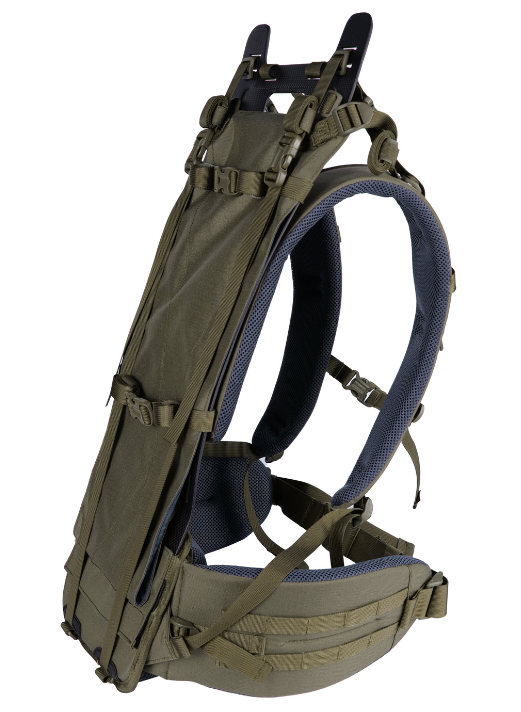
Load transfer. On a real pack-out the question is not comfort, it is whether you can walk out. A rigid frame and load shelf let a quarter sit low against the frame, with the weight on the hip belt instead of the shoulders — the difference between a hard hour and an impossible one.
Ventilation. An external frame holds the bag off your back so air moves between the two — worth carrying on long climbs.
Leverage. The same geometry that helps with weight hurts on steep ground: a pack that stands off the back swings when you traverse a slope.
Which frame for which hunt
- Elk, deer, multi-day, pack-out: external frame, 65–85 L.
- Day hunts on foot: external frame day pack, or frameless under 8 kg.
- Alpine scrambles: internal frame, packed tight.
- Thick timber: lower profile wins — internal, or a compact external day pack.
Our frame platform
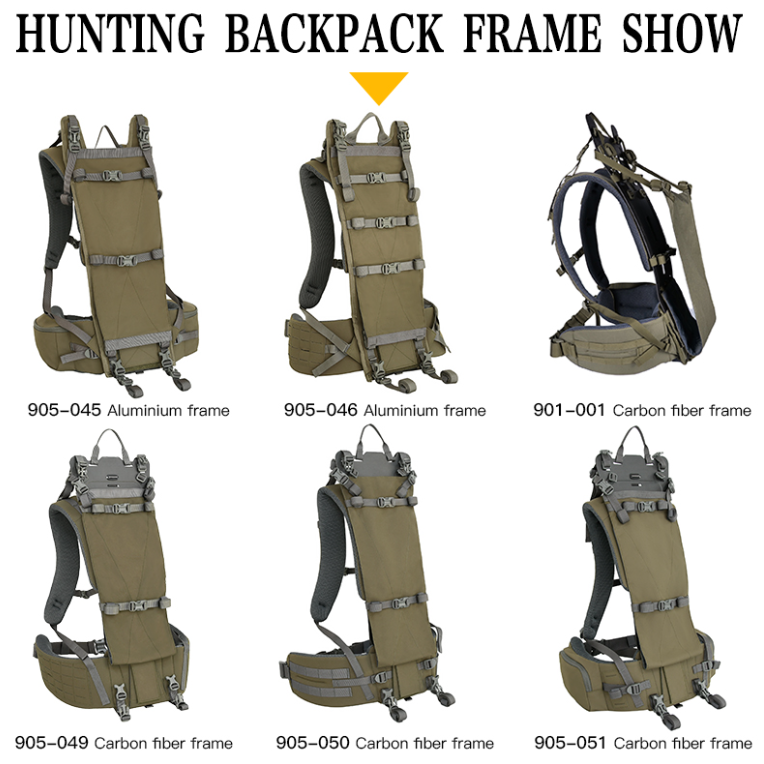
We build external frame hunting packs, because that is the configuration big-game hunting actually demands. Six frames are in current production: 905-045 and 905-046 in aluminium, and 901-001, 905-049, 905-050 and 905-051 in carbon fibre. Carbon saves weight where a hunter notices it — hour eight on a climb. Aluminium gives a stronger strength-to-cost ratio for value lines and the heaviest loads. Our frames carry packs across a shared 20 / 45 / 65 / 85 L volume platform with a load shelf and a meat bag rated to 150 lb / 68 kg.
Why brands develop frames with us
GAF OUTDOOR is a Guangzhou hunting backpack manufacturer with 10+ years of OEM/ODM experience and 50+ brand customers in the US, Europe and Australia. Our plant covers 3,300 ㎡ over 20 production lines with 350+ staff, sewing 30,000–50,000 backpacks a month — carbon and aluminium frame programmes included. Custom frame projects start at 300 pcs per style; branding an existing design at 50 pcs.
Next step: see the hunting backpack range, or send your load weight and terrain for a frame recommendation.

Short answer: Yes. Hunting gear is regional, and we build to the market rather than to one global specification. US buyers generally want larger frame packs, tree-stand friendly day packs and licensed camo. Europe favours muted olive and brown, driven-hunt stool packs and moderate volumes. Australia leans lighter, with hot-climate build details and drab green patterns. Logistics run FOB Shenzhen / Guangzhou, or DDP to your door.
How the specification changes by market
| United States | Europe | Australia | |
|---|---|---|---|
| Typical volume | 30–45 L day, 65–85 L pack-out | 20–35 L day, stool packs, 30–50 L | 35–50 L, multi-day |
| Colour and camo | Realtree, Next Camo, ABT, Prym1 | Olive, brown, grey-green, subtle patterns | Dark green, brown, drab solids |
| Extra requirements | Hunter-orange visibility options, rifle scabbard and bow carrier | Quiet build for driven hunts, seat-integrated stool packs | Lighter hardware, faster-drying liners and mesh |
| Frame | Carbon or aluminium external frame | Aluminium and carbon, moderate volumes | Carbon and light aluminium |
| Order pattern | Larger recurring volumes | Smaller runs, more colour depth | Broad size range per order |
Logistics, packing and documentation
- Terms. FOB Shenzhen / Guangzhou, or DDP door-to-door into the US, EU and Australia.
- Shipping. Air, sea or express, matched to your season rather than to convenience.
- Channel packing. Amazon FBA-ready cartons and labels, or your own retail packing.
- Documentation. Material specifications and, where your market requires it, chemical-compliance declarations for the fabrics and coatings specified on the order.
- Sampling. A physical sample goes out before production, so the market test happens on the real product rather than on a photo.

Two worked examples
A US brand launching an elk line. 80 L and 65 L carbon-frame packs with side rifle scabbards, licensed camo, hunter-orange visibility options on the day packs, and FBA-ready cartons. Volume sits at the pack-out end of the range, and the pack still has to be quiet enough to hunt with.
A European retailer refreshing a driven-hunt range. 30 L and 45 L packs in muted olive and brown, a seat-integrated stool pack, brushed faces throughout, and smaller runs spread across more colourways. The priority is quietness and a palette that sells from a shop shelf, not from a catalogue photograph.
Both projects run through the same design, sampling and inspection process — only the specification changes.
Why one factory can serve all three markets
Every difference above is a pattern, fabric or colour decision, and all of them are settled in the technical pack before sampling begins. Because we keep both a quiet brushed-tricot line and a nylon / Cordura line in house, a US pack-out build and a European driven-hunt pack can be developed in parallel without splitting your supply base or your approval calendar.
Next step: tell us your target market and we will send the standard specification we build for that region.
Short answer: Judge a Chinese hunting backpack manufacturer on six things: whether they are a factory or a trader, their capacity and equipment, their quality process and inspection records, their sampling speed, their camo and hardware capability, and their communication discipline. Ask every candidate for the same evidence on each point, and the field narrows quickly.
The six checks
| Check | What to ask | What a good answer looks like |
|---|---|---|
| Factory or trader | Which address actually cuts the fabric? | A named plant, a production line list, real equipment photos |
| Capacity | Monthly output, lines, operators, designers | Numbers that match across website, profile and quotation |
| Quality | Who inspects, at which step, with what record? | Named QC staff, in-line and final inspection, traceable records |
| Sampling | How fast, how many revisions, who draws the pattern? | 7–15 days, in-house pattern making, a free tech pack |
| Materials | Fabric library, camo options, hardware brands | A specified fabric range and licensed camo capability |
| Communication | Reply time, single point of contact, English documents | A committed response window and written specifications |
Red flags
- Capacity numbers that change between the website, the company profile and the quotation.
- No physical sample until a deposit has cleared.
- "We can do anything" — with no technical pack, no fabric list and no camo references behind it.
- Certificates offered without an original carrying the factory's own legal name.
- A quality process described only as "we check everything".
Three questions that end the conversation quickly
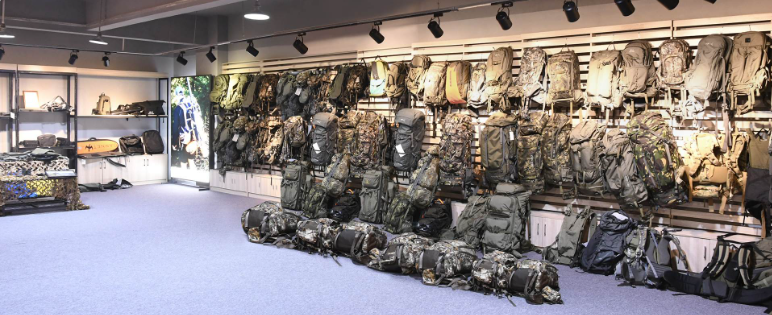
Ask for the six-step production flow, the inspection record from a recent order, and the brand name of the zipper and buckle supplier. A factory answers all three in a single reply. A trader forwards the question to somebody else and answers in a week.
How to verify a factory without flying there
- Video walk-through. Ask for a live call through the cutting floor and the sample room, not a download of edited footage.
- Order the sample. A physical sample is the cheapest audit available; it shows the stitch density and hardware quality in a size you can feel.
- Ask for one recent inspection record and one recent packing list. Paperwork with dates, quantities and signatures is difficult to construct after the fact.
- Check the equipment list against the product. Frame packs need high-head and heavy-duty machines; a plant without them cannot make one properly.
How we answer these questions
We are a Guangzhou-based hunting backpack manufacturer with in-house cutting, sewing, pattern making, an in-house testing lab and a dedicated sampling room. Our facility covers 3,300 ㎡ across 20 production lines with 350+ staff, producing 30,000–50,000 backpacks a month for buyers in the US, Europe and Australia. Production follows a documented six-step flow from fabric inspection to packing, with in-line and pre-shipment inspection, dedicated QA/QC inspectors and material traceability from incoming roll to packed carton. Third-party inspection by your nominated agency is welcome, and we will answer the checklist above line by line, in writing.
Next step: send us the checklist above and we will respond against every point.