loading

Professional Hunting Gear Manufacturer & Tactical Gear Supplier Since 2013

What Is a Hunting Stool Pack and Who Needs One?

2026-10-19

Short answer: A hunting stool pack — also called a chair pack — is a rucksack with a folding metal seat frame built into it. You carry your gear on your back, and when you reach the stand you sit on the pack. It is the standing answer to European driven hunts and long ground sits: one load instead of two, and no separate stool left behind in the truck. Capacity runs 25–30 L, and the seat frame on our 30 L model is rated to 120 kg.

Stool pack vs the alternatives

Stool pack Folding stool + daypack Tree-stand seat
What you carry One item Two items to manage Seat stays on the stand
Seat frame Integral, folding metal Separate and loose Fixed
Gun rest Included on our 30 L model No Sometimes integrated
Capacity 25–30 L Whatever the pack holds —
Best for Driven hunts, long ground sits Static hunts near the truck Elevated stands
What Is a Hunting Stool Pack and Who Needs One? 1
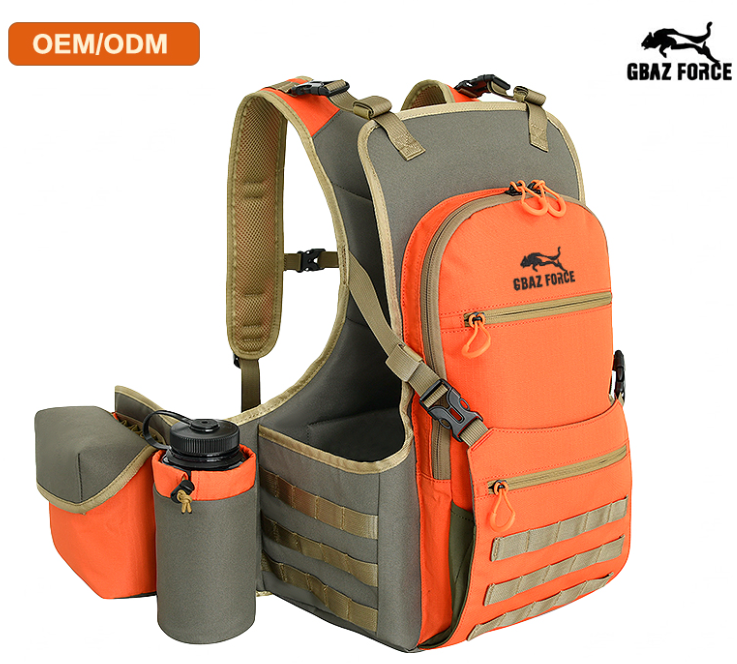
GAF OUTDOOR camo hunting stool pack — rucksack body with a folding metal seat frame and a fleece-topped backrest, shown from the rear quarter

The line at a glance

Model Capacity Seat frame Build
30 L chair pack 30 L Detachable metal, 120 kg rated Brushed quiet shell, includes gun rest
905-014 25 L Built-in seat 500D nylon, waterproof
1991 / 1992 / 905-013 / 905-015 — Folding frame Camo shells, padded waist belt

A detachable frame folds flatter for shipping and can be replaced without replacing the bag.

What Is a Hunting Stool Pack and Who Needs One? 2
GAF OUTDOOR 1992 stool pack with the metal seat frame deployed — fleece seat top, mesh back panel, padded waist belt and side mesh pockets

What to check before buying or specifying

  • The rated load on the seat frame. Ask for the figure in kilograms. 120 kg is what makes a frame safe for a heavy hunter in winter clothing.
  • Detachable or fixed frame. Detachable ships flatter and is serviceable.
  • A gun rest. On a driven hunt the rifle is in your hands for hours; a rest built into the frame is worth more than another pocket.
  • Quiet fabric. Rustle gives you away — brushed shells are the quietest option, with waterproof 500D nylon when weather is the bigger risk.
  • Waist belt and back panel. You are carrying the pack and the frame, so a padded belt and a ventilated back panel decide whether hour four is comfortable.

Who needs one

Driven hunts with a stand number, roe and red deer stalking with long glassing sessions, and any ground hunt where you sit for hours in one spot. If you walk for miles and rarely sit, a plain day pack is lighter; if you sit more than you walk, the stool pack wins.

Why brands source them from us

GAF OUTDOOR has 10+ years of OEM/ODM experience and 50+ brand customers in the US, Europe and Australia, from a 3,300 ㎡ plant with 20 production lines and 350+ staff. Stool packs use the same quiet shells, camo library and hardware as our day packs — sample in 7–15 days, custom OEM from 300 pcs per style, branding an existing design from 50 pcs.

Next step: see the 905-014 25L stool pack, or send your seat height and load requirement and we will match the model.
prev
What Is a Hunting Vest and What Should It Carry?
Related questions
1
What Is a Hunting Vest and What Should It Carry?

Short answer: A hunting vest is a sleeveless carry system worn over a shirt or jacket that keeps the gear you reach for constantly — shells, calls, a rangefinder, water — on your chest and waist, and puts what you harvest in a rear game bag. The three types are the turkey vest, the upland or bird vest, and the general-purpose hunting vest. Capacity runs from a few pockets to a 25 L rear pack panel.

The three types

Turkey vest Upland / bird vest General hunting vest
Main job Long sits in one spot Walking up birds Layering plus gear
Signature feature Detachable seat cushion, call pockets Front-access game bag, blaze orange Chest and waist pockets
Capacity 25 L rear pack Pockets plus game bag Light to moderate
Water Bottle sleeve Bottle sleeve and MOLLE Hydration compatible
Our models 905-054 (25 L) 905-063 901-23, GA-TV-01

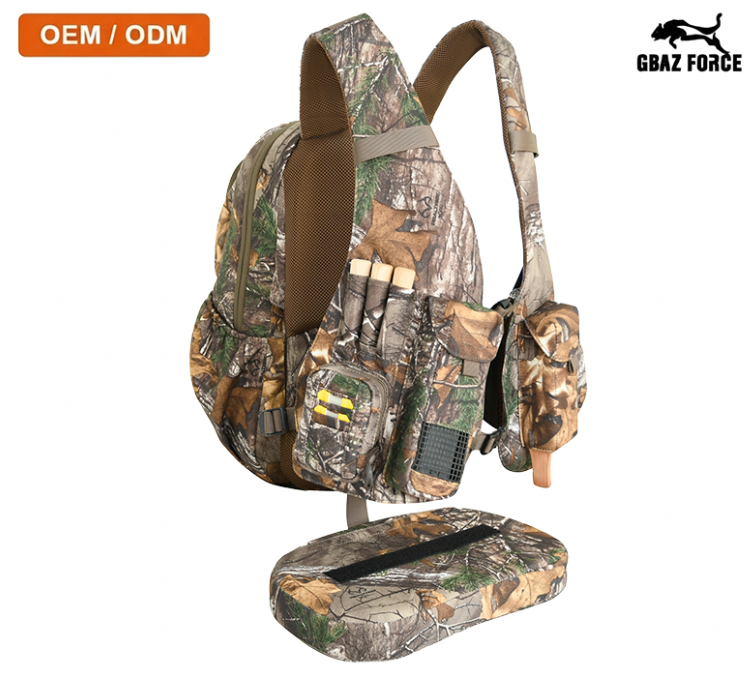
GAF OUTDOOR 905-054 25L turkey vest in camo — adjustable shoulder straps, multi-pocket layout for turkey calls and rangefinder, and the detachable 5 cm quick-release seat cushion

What a vest should carry

  • Shell loops or a shell pouch within reach of your reloading hand.
  • Dedicated call pockets, so a slate and a box call are not fighting for the same space.
  • A rangefinder or GPS pocket on the chest, where you can reach it while sitting down.
  • A rear game bag, front-access if you walk — that is what keeps a bird cool and out of your hands.
  • A detachable seat cushion. On the 905-054 it is 5 cm thick and unclips instantly, which is what makes a long sit workable.
  • Water. A bottle sleeve or hydration sleeve beats a bottle loose in a coat pocket.
  • Blaze orange panels for upland seasons that require visibility.

GAF OUTDOOR 905-063 upland bird vest in blaze orange and grey — front-access game bag, MOLLE and multi-pocket layout, water bottle sleeve and an adjustable ergonomic harness

Fit and construction notes

A vest is worn over layers, so the harness has to adjust across a heavy jacket as well as a shirt — buckle-adjustable shoulder straps rather than fixed webbing. Look for mesh where the vest meets your back, and check that the game bag drains: a wet bird left in a sealed compartment is the fastest way to spoil a hunt.

In production terms a vest is a small order item — fewer panels than a pack, but more hardware and pockets per unit — which makes the pocket layout the single biggest decision in the technical pack.

Why brands source vests from us

GAF OUTDOOR has 10+ years of OEM/ODM experience and 50+ brand customers in the US, Europe and Australia, from a 3,300 ㎡ plant with 20 production lines and 350+ staff. Vests run on the same camo library, MOLLE webbing and hardware as our packs — sample in 7–15 days, custom OEM from 300 pcs, branding an existing design from 50 pcs.

Next step: see the hunting vest range, or send your pocket layout and target species for a spec and quote.

2
What Are Hunting Gaiters and Which Type Do You Need?

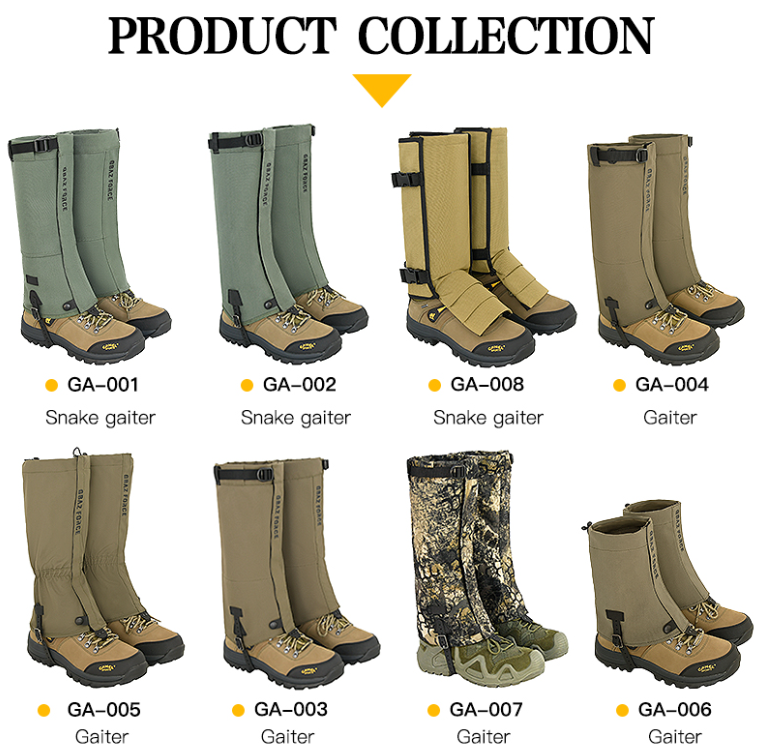
Short answer: Hunting gaiters are fabric tubes worn over the boot and lower leg to close the gap between the boot top and your trouser hem. That gap is where water, mud, briars, ticks and seed heads get in — and in snake country it is where a strike lands. Our range covers eight models, from 390 mm snake gaiters to short canvas gaiters, in M / L / XL calf sizes.

The four types

Snake gaiter 500D nylon long gaiter Camo gaiter Short canvas gaiter
Main job Reinforced panel over the shin Water, mud and brush protection Concealment plus brush cover Light cover in warm weather
Material Bonded canvas 500D nylon Camo print shell Canvas
Height 390 mm Over-calf Over-calf Above the ankle
Models GA-001, GA-002, GA-008 GA-003, GA-004, GA-005 GA-007 GA-006
Best for Upland and thorn country Wet ground, driven hunts Stalking and concealment Early season, light cover

GAF OUTDOOR gaiter range — eight models shown on boots, including the GA-001, GA-002 and GA-008 snake gaiters plus the GA-003 to GA-007 long and camo gaiters

Sizing

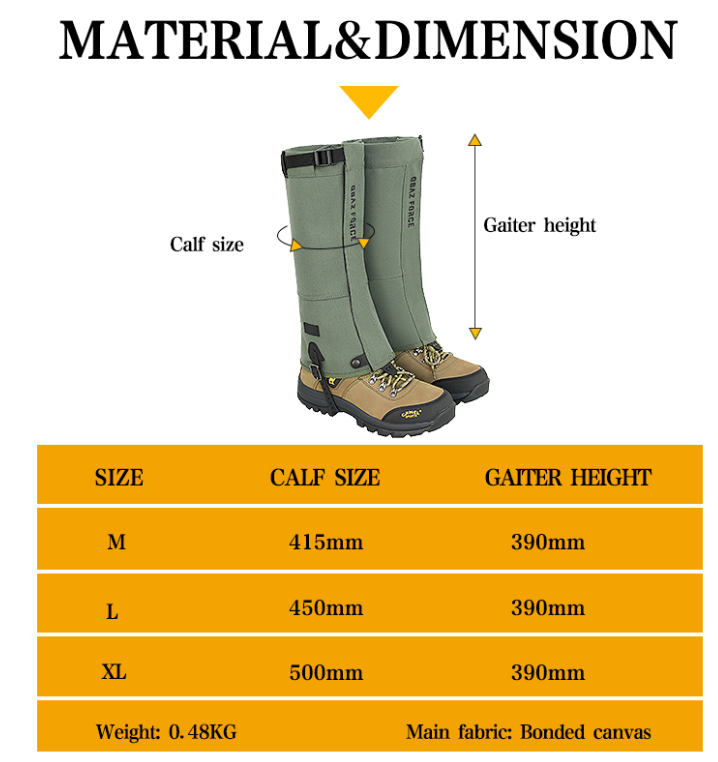
Size Calf size Gaiter height
M 415 mm 390 mm
L 450 mm 390 mm
XL 500 mm 390 mm

On the GA-001, the complete pair weighs 0.48 kg in bonded canvas. Measure the widest point of your calf over the trousers you hunt in — that, not shoe size, is what decides M, L or XL.


GAF OUTDOOR gaiter dimensions — calf size and gaiter height chart for M, L and XL sizes, with pair weight and main fabric

What to look for

  • A full-length front closure. A zip backed by hook-and-loop opens wide enough to fit over boots and stays shut in brush.
  • A top cinch strap. Without one, a gaiter slides down the calf within an hour of walking.
  • An under-boot instep strap. This is what keeps the hem anchored to the boot; a lace hook alone is a weaker alternative.
  • A reinforced front panel on snake models, where the shin takes the contact.
  • Quiet fabric if you stalk. 500D nylon is tough but audible; bonded canvas and brushed faces are quieter.
  • Camo matching to the rest of your line, or Pantone colour matching for solid colourways.

Where they fit in a hunt

Gaiters are the cheapest way to extend a boot you already own. They turn a 6-inch boot into over-calf protection for wet ground, snake country or a briar field, and they pack flat when you do not need them.

Why brands source gaiters from us

GAF OUTDOOR has 10+ years of OEM/ODM experience and 50+ brand customers in the US, Europe and Australia, from a 3,300 ㎡ plant with 20 production lines and 350+ staff. Gaiters run on the same camo library, hardware and QC process as our packs — sample in 7–15 days, custom OEM from 300 pcs, branding an existing design from 50 pcs.

Next step: see the gaiter range, or send your calf and boot measurements for a size and spec recommendation.

3
What Size Rifle Case Do I Need for Hunting?

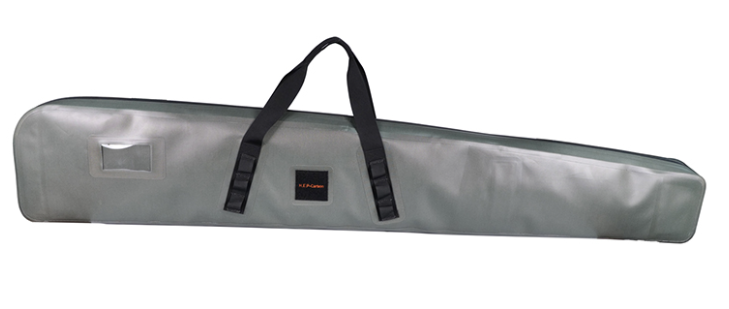
Short answer: Measure your rifle from the muzzle to the end of the buttstock — including any muzzle brake or suppressor — then add 2–3 inches. Cases in our range run from 44.5 to 52.8 inches inside, which covers a compact carbine through to a magnum bolt-action with a long brake. Then match the construction to the job: soft padded for the truck and the field, hard shell for airlines, welded waterproof for boat and waterfowl.

Inside length: what to pick

Inside length Models Suits a rifle measuring up to
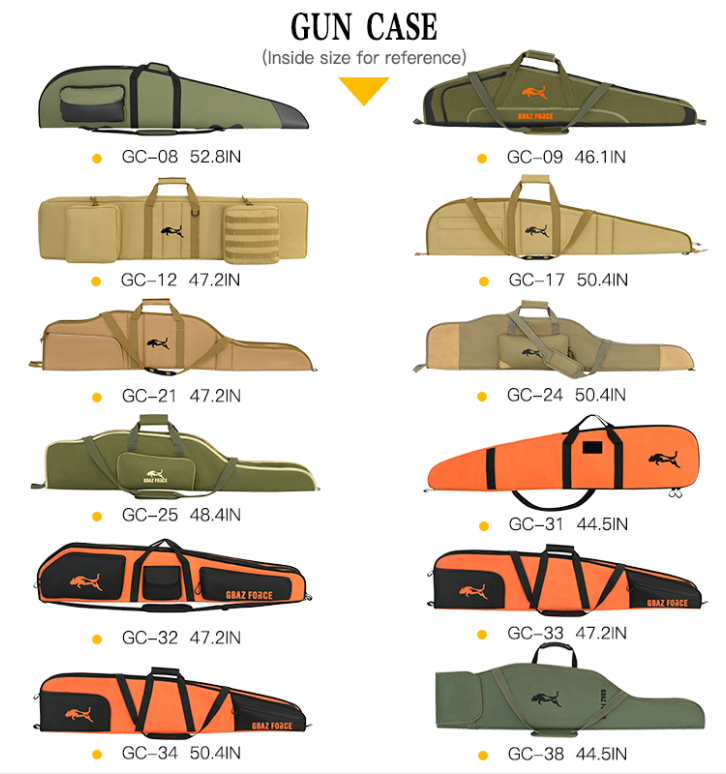
44.5 in GC-31, GC-38 ~41 in overall — carbines, lever actions, youth rifles
46.1 in GC-09 ~43 in — compact scoped bolt-actions
47.2 in GC-12, GC-21, GC-32, GC-33 ~44 in — the standard scoped hunting rifle
48.4 in GC-25 ~45 in — long-action bolt rifles with optics
50.4 in GC-17, GC-24, GC-34 ~47 in — magnum barrels and rifles with brakes
52.8 in GC-08 ~49 in — extra-long barrels and shotgun rigs

GAF OUTDOOR gun case range — inside size reference chart covering twelve models with inside lengths from 44.5 to 52.8 inches

How to measure

1. Fit the rifle the way you hunt it. Scope mounted, brake or suppressor fitted, sling attached. 2. Measure muzzle to buttstock, not barrel length. Barrel length tells you nothing about case size. 3. Add 2–3 inches. That margin is what stops a scope turret or a front sight from pressing into the end wall. 4. Check width and depth too. A large objective with tall turrets needs a case wide enough at the scope line, not just long enough.

Soft, hard or welded

Soft padded case Hard shell case Welded waterproof case
Protection Padding against knocks and dust Rigid shell against impact and crush Sealed against water and mud
Weight Light Heavy Light to moderate
Airline travel Not recommended The right choice for checked baggage —
Weather Water-resistant fabric Weather-resistant Fully sealed construction
Best for Truck, blind, day hunts Flying, long haul, high-value rigs Boat, float trips, waterfowl, ATV
Typical build 600D–900D oxford, foam lined Padded walls, internal straps TPU-welded panels, sealed seams

GAF OUTDOOR 2103-HY waterproof rifle case — welded waterproof construction with sealed carry handles for boat, float trip and waterfowl use

Four features worth specifying

  • Foam thickness where the receiver and scope rest, not just at the two ends.
  • An internal tie-down or strap so the rifle cannot slide forward in transit.
  • A full-length zipper with a storm flap on soft cases; a sealed closure on waterproof ones.
  • Camo or solid colour, matched to the rest of your line.

Why brands source cases from us

GAF OUTDOOR has 10+ years of OEM/ODM experience and 50+ brand customers in the US, Europe and Australia, from a 3,300 ㎡ plant with 20 production lines and 350+ staff. The gun case line is our widest programme — 600D to 900D oxford, hard-shell and welded waterproof constructions, sharing the same camo and hardware library as our packs.

Next step: see the rifle case range, or send your rifle's overall length and we will match the model.
4
What Is the Difference Between Water-Repellent and Waterproof Hunting Backpacks?

Short answer: Water-repellent means the fabric carries a DWR finish that makes rain bead and roll off, but the shell wets out and water can still pass through seams, zippers and stitch holes. Waterproof means the shell is coated or laminated and the seams are sealed, so water cannot pass — and with an IPX7 airtight zipper the pack survives immersion. Most hunting packs should be water-repellent; float trips and waterfowl need waterproof.

Three levels

Water-repellent (DWR) Waterproof (coated, sealed) Submersible (IPX7 airtight)
What it means Rain beads off the face Water cannot pass shell or seams Sealed against temporary immersion
Zipper Standard YKK coil TPU-coated or AquaGuard zipper IPX7 airtight and waterproof zipper
Seams Sewn, not sealed Sealed or taped at critical seams Fully sealed, welded construction
River crossing or capsize Not designed for it Water may reach the zipper Survives temporary immersion
Typical use Day hunts, stalking Multi-day hunts, wet climates Float trips, waterfowl, boat access

Why it matters on a hunt

  • Optics and electronics are the first casualties: a wet rangefinder or phone ends the day.
  • Multi-day rain and water access. A DWR finish wets out over hours and water migrates through stitch holes, so if you wade, cross or hunt from a boat, only a sealed pack is the right answer.
  • Weight and noise trade off. Sealed zippers add weight, and the quietest brushed-tricot faces are usually water-repellent rather than sealed.

Five checks when you specify one

1. Coating type. Nylon with DWR plus PU is the value route; a DWR plus TPU bond is more durable and is what we use on quiet brushed faces. 2. Zipper class. A standard coil zip is not waterproof, a TPU-coated zip resists rain, and only IPX7 airtight survives immersion. 3. Seam treatment. Ask whether seams are sealed or taped, or only sewn. 4. Where the water gets in. Test the zipper line, the base and the strap attachment points. 5. The honest rating. Ask what the pack is rated for — rain, spray or immersion — in writing.


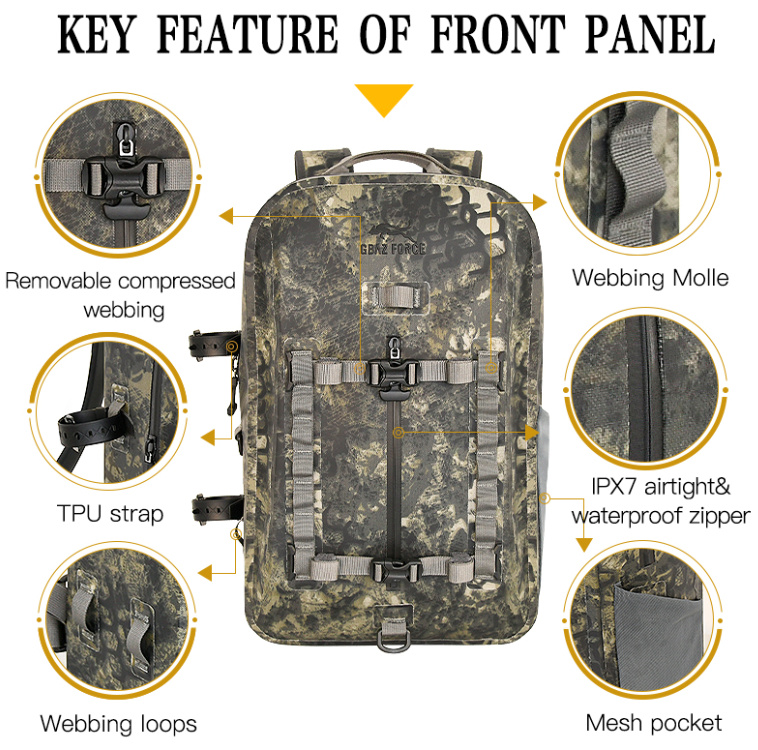
GAF OUTDOOR 906-001 waterproof backpack front panel — IPX7 airtight and waterproof zipper, TPU strap, webbing loops and webbing MOLLE

What we build

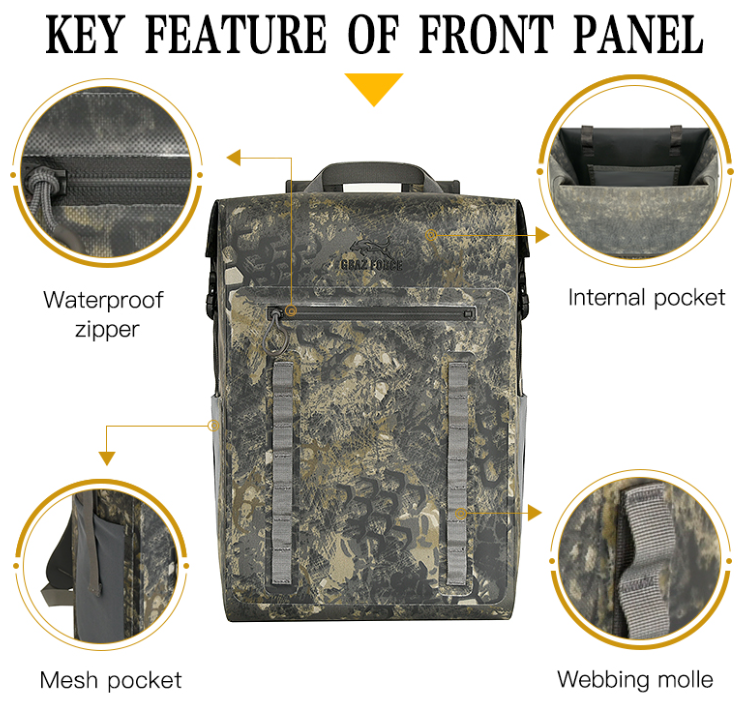
Our waterproof line covers all three levels. The 906-001 and 906-008 backpacks use an IPX7 airtight and waterproof zipper with TPU straps, webbing MOLLE and sealed panels, and the dry-bag programme adds 840D nylon TPU dry packs plus the 50L / 100L floating waterproof duffel. On the hunting side, nylon bodies are finished with DWR plus PU, and brushed-tricot quiet faces use a DWR with TPU bond — so a pack stays quiet and sheds weather.


GAF OUTDOOR 906-008 waterproof backpack front panel — waterproof zipper, internal pocket, mesh pocket and webbing MOLLE

Why brands source waterproof packs from us

GAF OUTDOOR has 10+ years of OEM/ODM experience and 50+ brand customers in the US, Europe and Australia, from a 3,300 ㎡ plant with 20 production lines and 350+ staff. Coating, zipper class and seam sealing are all fixed in the technical pack before sampling.

Next step: see the waterproof dry bag range, or send your water-exposure requirement and we will specify the coating, zipper and seam treatment.

5
What Is a Bino Harness and What Should You Look For When Buying One?

Short answer: A bino harness is a chest-mounted carrier that holds binoculars flat against your sternum on two shoulder straps, so your glass is always in reach and never swinging from your neck. Most hunting versions add a rangefinder pouch, call pocket or bear-spray holder, and the good ones open with a bungee closure rather than a zipper or hook-and-loop, so they stay silent.

Bino harness vs neck strap vs chest pack

Bino harness Neck strap Chest pack
Carry position Chest, held flat against the sternum Neck, free to swing Chest, rigid box
Access One-hand, one-motion bungee opening Slow; arrives tangled Unzip or flip lid
Noise Silent with a bungee or elastic closure Strap rub, binos knocking together Zipper and hook-and-loop
Protection Padded shell, DWR or TPU-coated face, rain cover None High — hard shell
Modularity Rangefinder pouch, call pocket, bear spray, radio None Limited

Why hunters wear one

  • Access and silence. Glass at your chest is one small hand movement, and a bungee closure defeats the two loudest failures of a strap: rub and knock.
  • Protection. Dust, rain and brush damage optics; a padded shell and a water-repellent face keep glass usable.
  • Load balance and pack fit. Two straps over the shoulders beat weight on the neck, and the harness sits under backpack straps without fighting a rifle scabbard or bow sling.

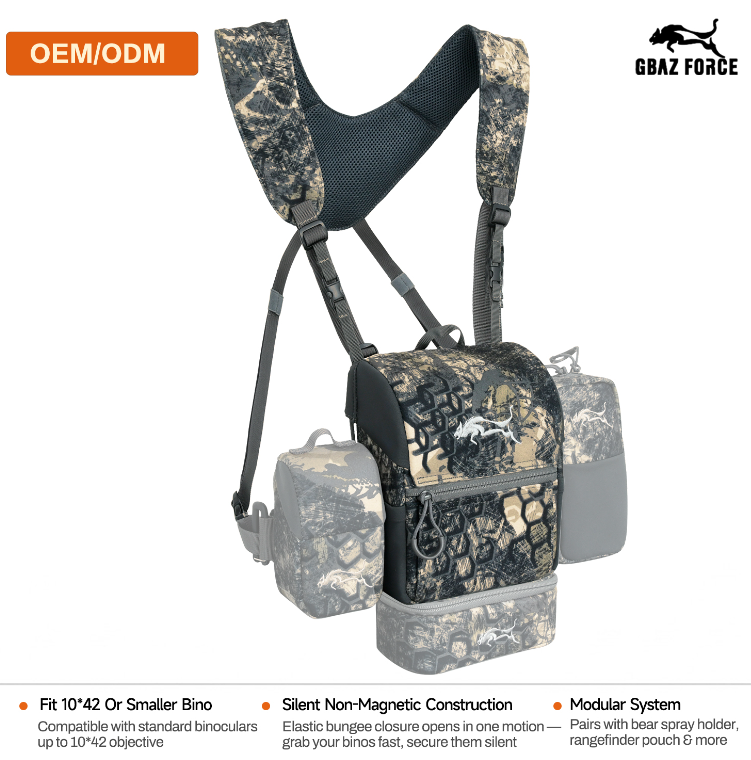
GAF OUTDOOR 905-018 camo bino chest pack — mesh shoulder yoke, elastic bungee closure for silent one-motion access, MOLLE panel, shown with its modular accessory pouches

Six checks before you buy or spec one

1. Bino size. Most are built around a 10×42 or smaller objective. Check the internal dimension, not the photo. 2. Closure type. A bungee or elastic closure opens in one motion and shuts silently. Avoid hook-and-loop near optics. 3. Face fabric. Brushed tricot absorbs surface rustle; woven nylon and ripstop do not. 4. Weather protection. Padded walls, a DWR or TPU-coated face, and a rain cover for full days out. 5. Modularity. A rangefinder pouch, call pocket, bear-spray holder and radio slot decide whether it suits your hunt or one season. 6. Fit. A mesh shoulder yoke and fully adjustable straps, sized to sit over a jacket and under pack straps.

The series we build

Our 905-018 bino chest pack fits a 10×42 or smaller binocular, closes with an elastic bungee for silent one-motion access, and pairs into a modular family: 905-016 rangefinder pouch, 905-017 phone or utility pouch, 905-020 bottom utility pouch, 905-021 bear-spray holder, 905-035 pistol pouch and 905-036 radio pouch. The 901-28 brushed-tricot harness remains in production for the quietest possible face. Both use 500D Cordura or 500D nylon with brushed tricot where it counts.


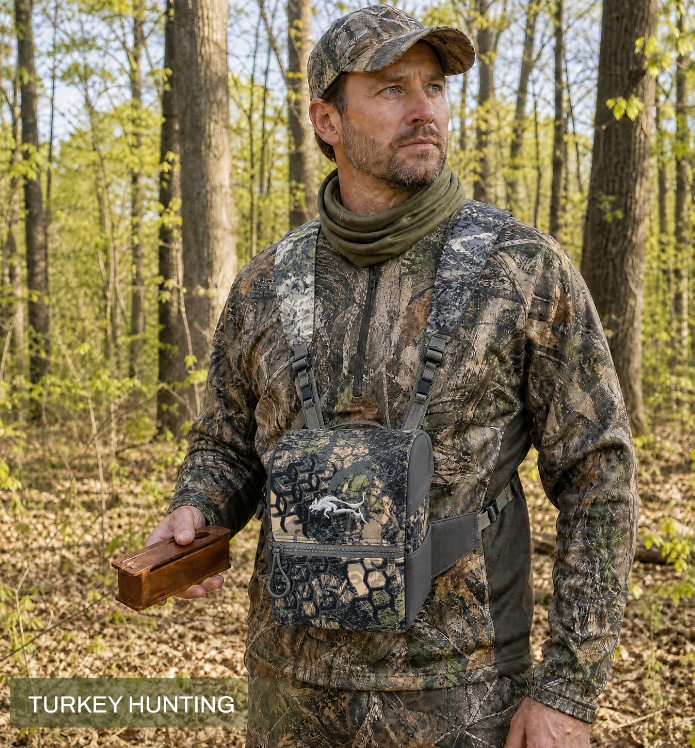
GAF OUTDOOR 905-018 bino chest pack in the field — worn over camo clothing on a turkey hunt

Why brands source harnesses from us

GAF OUTDOOR has 10+ years of OEM/ODM experience and 50+ brand customers in the US, Europe and Australia, from a 3,300 ㎡ plant with 20 production lines and 350+ staff. Harness programmes share the same camo library, hardware and QC process as our packs.

Next step: see the binocular harness range, or send your bino model and required accessories for a specification and quote.

6
What Is the Difference Between an Internal and an External Frame Hunting Backpack?

Short answer: An external frame sits outside the pack bag on a rigid carbon or aluminium structure, so heavy and awkward loads — including an animal quarter — transfer straight to your hips through the belt. An internal frame is sewn into the pack and hugs the body, which balances better on steep, technical ground and in thick brush. For big-game pack-outs, external wins. For alpine scrambling, internal usually feels better.

Side by side

External frame Internal frame
Structure Rigid frame outside the bag; bag often detachable Frame sewn inside the pack, against the back
Load transfer Direct to the hip belt; strongest at 25–35 kg Good, but the load rides closer to the shoulders
Meat hauling Load shelf plus a meat bag; the frame carries the load Limited — usually a bag inside the pack
Ventilation Air gap between the back and the pack Panel contact, less airflow
Rough, steep ground More leverage; the pack swings on the frame Better balance in scrambles and tight timber
Best for Elk, deer, pack-outs, heavy multi-day loads Light fast hunts, alpine, thick brush

Why the frame decides the hunt

Load transfer. On a real pack-out the question is not comfort, it is whether you can walk out. A rigid frame and load shelf let a quarter sit low against the frame, with the weight on the hip belt instead of the shoulders — the difference between a hard hour and an impossible one.

Ventilation. An external frame holds the bag off your back so air moves between the two — worth carrying on long climbs.

Leverage. The same geometry that helps with weight hurts on steep ground: a pack that stands off the back swings when you traverse a slope.


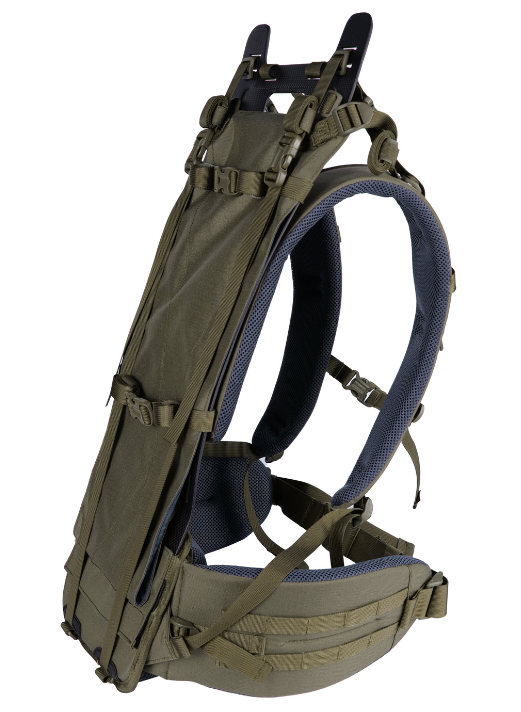
GAF OUTDOOR 901-001 carbon fibre external frame — rigid frame, ventilated back panel, load shelf and MOLLE hip belt

Which frame for which hunt

  • Elk, deer, multi-day, pack-out: external frame, 65–85 L.
  • Day hunts on foot: external frame day pack, or frameless under 8 kg.
  • Alpine scrambles: internal frame, packed tight.
  • Thick timber: lower profile wins — internal, or a compact external day pack.

Our frame platform

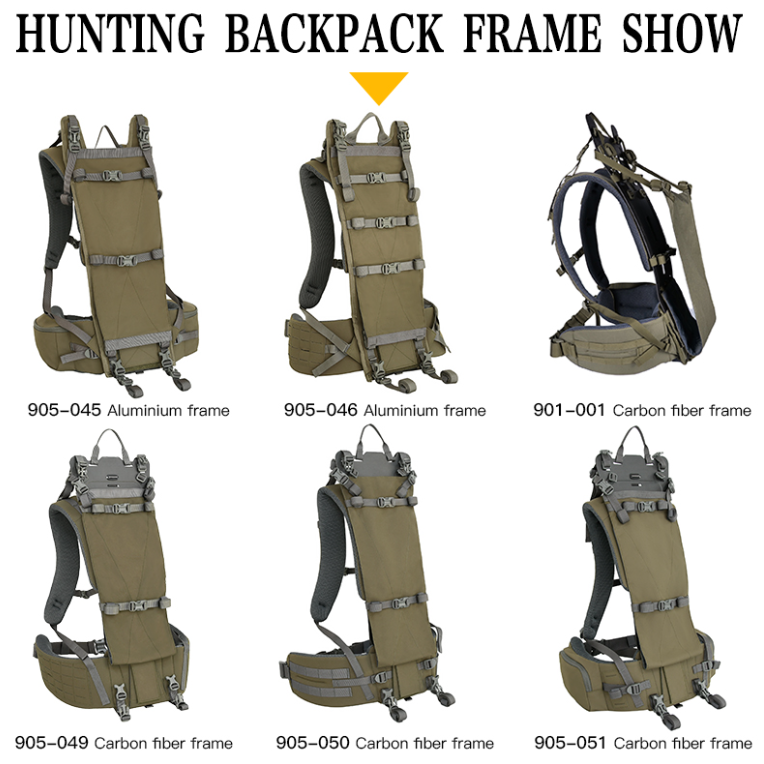
We build external frame hunting packs, because that is the configuration big-game hunting actually demands. Six frames are in current production: 905-045 and 905-046 in aluminium, and 901-001, 905-049, 905-050 and 905-051 in carbon fibre. Carbon saves weight where a hunter notices it — hour eight on a climb. Aluminium gives a stronger strength-to-cost ratio for value lines and the heaviest loads. Our frames carry packs across a shared 20 / 45 / 65 / 85 L volume platform with a load shelf and a meat bag rated to 150 lb / 68 kg.


GAF OUTDOOR hunting backpack frame range — 905-045 and 905-046 aluminium frames, plus 901-001, 905-049, 905-050 and 905-051 carbon fibre frames

Why brands develop frames with us

GAF OUTDOOR is a Guangzhou hunting backpack manufacturer with 10+ years of OEM/ODM experience and 50+ brand customers in the US, Europe and Australia. Our plant covers 3,300 ㎡ over 20 production lines with 350+ staff, sewing 30,000–50,000 backpacks a month — carbon and aluminium frame programmes included. Custom frame projects start at 300 pcs per style; branding an existing design at 50 pcs.

Next step: see the hunting backpack range, or send your load weight and terrain for a frame recommendation.

GET IN TOUCH WITH Us
Add:
1# Shangjie Hehe Road Hecheng Shiling Town Huadu District Guangzhou City 510850 China
Contact person

july

Have any questions?
july-bags@foxmail.com
Call us
+86 13922517997
Follow us
Copyright © 2026 GAF | Sitemap
Customer service
detect